
When the Founder Becomes the Bottleneck: How to Get Out of Your Own Company’s Way
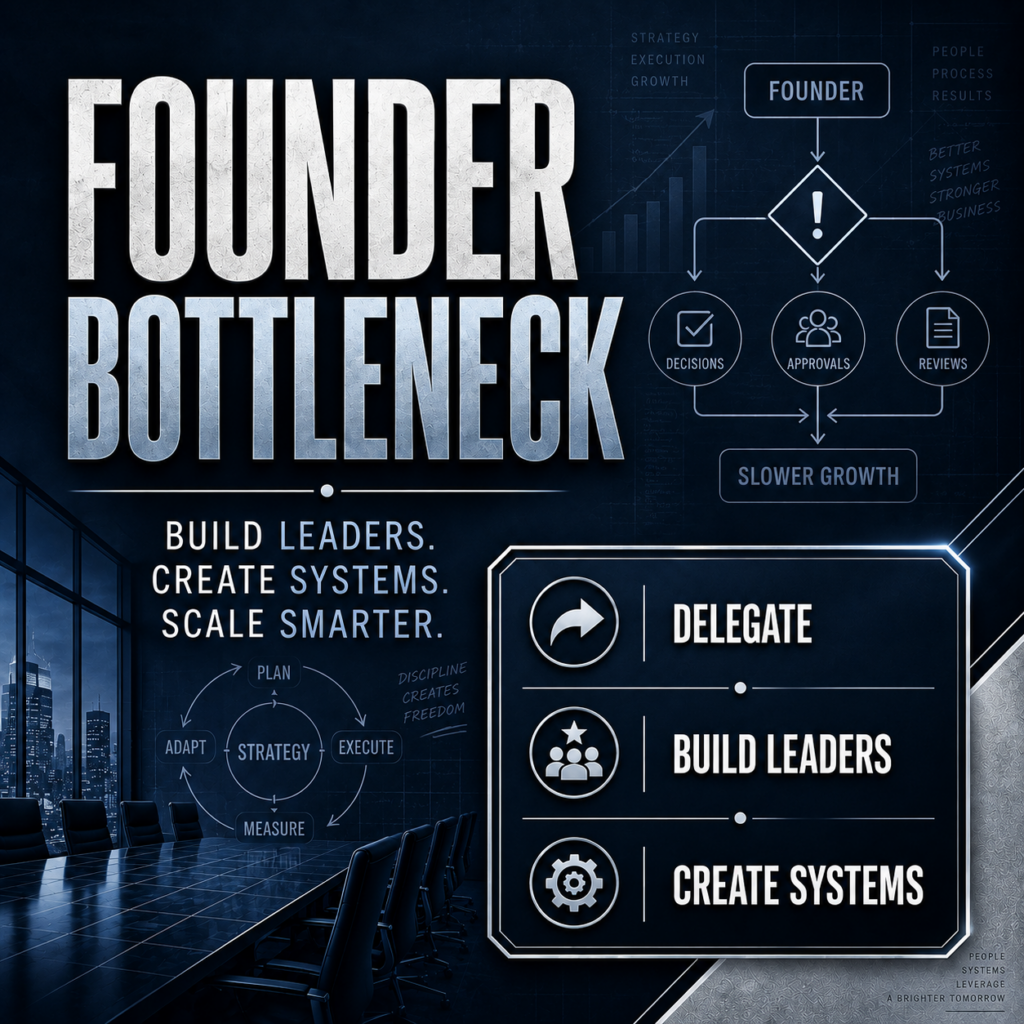
In the beginning, being involved in everything is often a strength. You know every customer. You approve every expense. You make the important sales calls. You solve the problems. You interview the employees. You know where the money is going. That level of involvement can be exactly what a young company needs. Then the company grows. More customers. More employees. More locations. More decisions. More money at risk. And the same founder who helped create the growth can suddenly become the person slowing it down. That is the founder bottleneck. I have spent more than 30 years building businesses, and one of the biggest transitions an entrepreneur has to make is realizing that the job changes as the company grows. What made you valuable at the beginning may eventually become the thing you have to stop doing. What Is a Founder Bottleneck? A founder bottleneck exists when too much of the company’s ability to move depends on one person. Usually the founder. Decisions wait for you. Problems wait for you. Deals wait for you. Employees wait for you. Customers wait for you. Managers wait for you. Eventually the company begins moving at the speed of your available time. That creates a hard ceiling. There are only so many hours in your day. If every meaningful decision requires the founder, the business can never become dramatically larger than the founder’s personal capacity. The Problem Usually Starts With Good Intentions Most founders do not intentionally create this problem. They care. They want things done correctly. They know the business better than anyone. They remember how hard it was to get the company started. And usually they are pretty good at solving problems. So people naturally keep bringing problems to them. The founder starts thinking: It will take me five minutes to handle this. That may be true. But if 40 people each bring you one five minute problem, you no longer have a five minute problem. You have built a system where everyone is trained to escalate instead of decide. That does not scale. If Every Decision Comes to You, You Do Not Have Leaders Yet One of the clearest signs of a founder bottleneck is constant approval. Can I hire this person? Can I give this customer a refund? Can I negotiate this contract? Can I spend this money? Can I change the process? Can I solve the problem this way? There should absolutely be decisions that require the CEO. But if competent executives cannot make meaningful decisions without asking permission, either you hired the wrong people or you have not actually given them authority. A title does not create a leader. Responsibility and decision making authority do. If you hire a great operator and then require them to operate exactly the way you would, you are wasting the reason you hired them. Your Job Changes as the Company Grows The CEO of a startup and the CEO of a large company should not have identical calendars. Early in the business, the founder may need to: Sell. Recruit. Build the product. Solve customer problems. Negotiate leases. Manage vendors. Review expenses. Create marketing. Do whatever needs to be done. That is entrepreneurship. But as the business scales, the founder’s highest value should begin moving toward: Vision. Strategy. Capital allocation. Major negotiations. Key relationships. Executive talent. Culture. Large opportunities. Critical decisions. Seeing around corners. Those are areas where the CEO can create disproportionate value. The goal is not to work less. The goal is to spend your time where it creates the most leverage. Ask Yourself: What Can Only I Do? This is one of the most useful questions a founder can ask. What am I doing today that truly requires me? Be honest. There are probably things you enjoy doing. Things you are good at. Things you have always done. That does not mean you should continue doing them. If someone else can perform a task at 90% of your ability, and doing so frees you to work on something that could materially change the company, that may be a very good trade. The CEO’s time should increasingly move toward decisions and opportunities where the CEO is uniquely valuable. Everything else deserves scrutiny. Hire People Who Are Better Than You I have never believed the CEO should be the best person in the company at everything. That would be a terrible organizational design. Throughout my career, I have worked alongside people whose strengths are very different from mine. I naturally gravitate toward vision, strategy, opportunities, and negotiation. That becomes far more valuable when strong operators are translating ideas into execution and strong financial minds are creating structure around them. The company becomes stronger because the skills are complementary. You should want executives who make you less necessary in their area. The great CFO should know finance better than you. The great operator should know operations better than you. The great sales leader should be able to run the sales organization without waiting for you. That is not losing control. That is building a company. The Right Executive Is a Force Multiplier A force multiplier creates an outsized increase in effectiveness. Great executives do exactly that. The right person does not simply take work off your desk. They improve the work. They build systems. They develop people. They catch problems earlier. They create accountability. They make decisions. They expand what the company is capable of doing. That is a very different hire from someone who simply completes tasks. As your company grows, you should increasingly be looking for people who can own outcomes, not just activities. Delegation Without Standards Is Abdication There is another side to this. Getting out of the way does not mean disappearing. You cannot tell someone: Handle operations. Then return six months later and be surprised by the result. Effective delegation requires clarity. What does success look like? What are the non negotiable standards? Which numbers matter? What authority does the person have? Which decisions still require escalation?
The Relationship Advantage: Why the Right People Make Businesses Move Faster

Entrepreneurs spend a lot of time thinking about speed. How quickly can we launch? How quickly can we hire? How quickly can we raise capital? How quickly can we enter a new market? How quickly can we solve the problem standing in front of us? After more than 30 years in business, I have come to believe there is a force multiplier behind many of those answers that entrepreneurs do not measure nearly enough: Relationships. The right relationship creates speed. When you know the right person, you do not necessarily have to spend three months researching an unfamiliar problem. You make a phone call. That phone call could save you months or even years of making the same mistake someone else already made and having to undo the damage. When you need a specialized attorney, you do not start with a search engine and hope you choose correctly. You call someone you trust and ask who they trust. When you are considering an acquisition, raising capital, entering a new market, hiring an executive, negotiating a complicated agreement, or solving an operational problem, access to someone who has already been there can compress the learning curve dramatically! That is why I have never thought of relationships as something separate from business. Relationships are part of the infrastructure of business. Business Relationships Are About More Than Networking Networking has its place. I have met plenty of great people at conferences, dinners, events, meetings, and through introductions over the years. But meeting someone is not the same thing as having a relationship with them. There is a big difference between someone whose contact information is in your phone and someone you know you can call when something really matters. A real business relationship has history behind it. Trust. Shared experiences. Follow through. Respect. That is relationship equity. You build it over time, and eventually it becomes one of the most valuable assets you have. Relationships Compress Time One of the greatest advantages of a strong relationship is access to someone else’s experience. Imagine you run into a business problem you have never seen before. You can research it. You can hire consultants. You can read everything available. You can make a decision and learn from whatever happens next. There is nothing wrong with any of that, and sometimes that’s the only option! But what if you also know somebody who encountered almost the exact same problem five years ago? They may be able to tell you in one conversation: What they tried. What worked. What failed. What they wish they had known. Who they used. What the warning signs were. What they would do differently today. They are not making your decision for you. They are shortening the distance between the problem and a better decision. That is an enormous advantage. Experience is valuable partly because experienced people recognize patterns faster. Relationships give you access to patterns you have not personally accumulated yet. There Is No Reason to Learn Every Lesson Yourself Entrepreneurs tend to be independent. That is often part of what made us entrepreneurs in the first place. We like solving problems. We like figuring things out. We are generally confident in our ability to find a way. Those qualities are valuable. But they can also become expensive if we convince ourselves that figuring something out personally is always the best approach. It isn’t. There is no trophy for making a mistake someone you trust could have warned you about. There is no extra credit for taking six months to understand something another person could have explained in an hour. There is no prize for finding the hard way. Good entrepreneurs solve problems. Great entrepreneurs also become very good at identifying who can help solve them faster. The People Around You Can Change Your Ceiling Throughout my career, I have been fortunate to work with some of the same people across multiple businesses and multiple stages of growth. That has taught me something important. You do not need everyone around you to have the same strengths. In fact, you probably do not want that. If the founder is a visionary, surrounding that person with five more visionaries may create a very exciting meeting and a very confused company. Someone has to execute. Someone has to understand the numbers. Someone has to build the structure. Someone has to protect the downside. Someone has to know the details. Someone has to challenge the assumption everyone else accepted. I have spent many years working closely with people whose strengths complement mine. I like thinking ahead. I enjoy strategy. I enjoy negotiations. I enjoy seeing where something can go. That becomes much more valuable when there are talented operators and financial minds around me who can turn that vision into something executable and scalable. The best relationships do not simply support what you already do well. They expand what you are capable of doing. That is what makes a person a force multiplier. What Is a Force Multiplier in Business? A force multiplier is something that creates an outsized impact on the effectiveness or results of a person or organization. Technology can be a force multiplier. Capital can be a force multiplier. A great system can be a force multiplier. But some of the most powerful force multipliers I have encountered are people. The right operator can multiply a founder’s vision. The right financial partner can multiply access to capital. The right salesperson can multiply distribution. The right attorney can protect years of work. The right connector can create an introduction that changes the trajectory of a company. The right advisor can identify a mistake before it becomes expensive. The right executive can take an area that required 30% of your attention and make it operate better without you. That is leverage. And relationships are how you gain access to much of it. Trust Creates Speed There is another reason long term relationships make businesses move faster. Trust reduces friction. When you have worked with someone for years, you begin to
How to Build Your Personal Board of Advisors Before You Need One
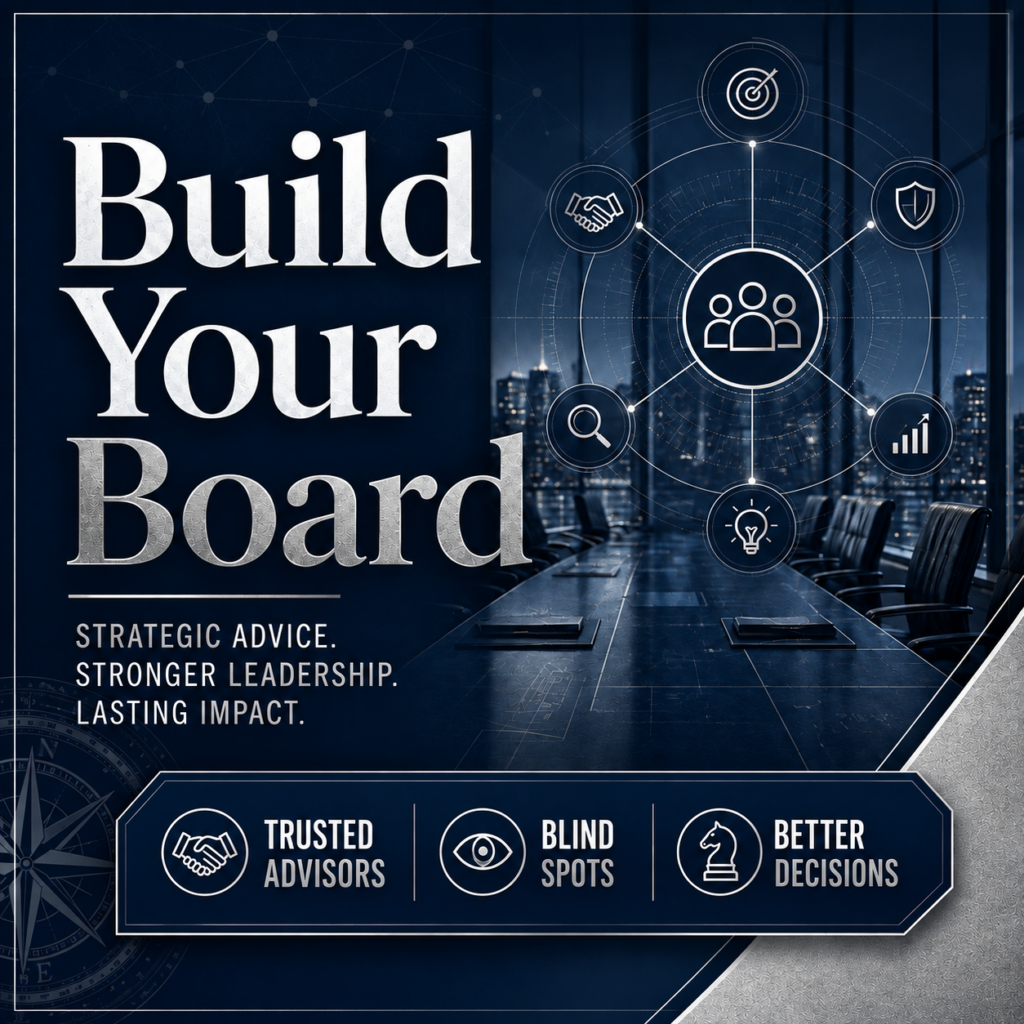
Most entrepreneurs eventually build a team inside their company. A salesperson. An accountant. An attorney. Managers. Executives. Maybe investors. But there is another group every serious entrepreneur should build intentionally: Your personal board of advisors. I am not talking about a legal board of directors. I am talking about trusted people you can call when the decision is important, the answer is unclear, or the situation falls outside your experience. People who understand different parts of business. People who have already traveled roads you are just beginning to walk. People who will challenge you. People who will answer the phone. And most importantly, people who do not need to agree with you. After more than 30 years in business, I believe one of the greatest advantages a CEO can create is access to the right people before they are needed. You do not want to start looking for the right advisor after the problem becomes an emergency. What Is a Personal Board of Advisors? A personal board of advisors is an informal group of trusted people whose collective experience helps you make better decisions. There does not need to be a conference table. There does not need to be a quarterly meeting. They may never all be in the same room. One might be an entrepreneur. One might be an attorney. One might understand capital. One might be an exceptional operator. Another might simply know you well enough to tell you when your judgment is being clouded by emotion or ego. What matters is that they expand what you are capable of seeing. You Cannot Be Great at Everything Entrepreneurs tend to be confident. We have to be. Building a company requires making decisions before the answer is obvious. But confidence becomes dangerous when it turns into the belief that the CEO should personally be great at everything. You cannot be. Neither can I. You may be great at sales and weak in finance. You may understand finance but struggle with people. You may be a strong operator without being a visionary. You may know your product better than anyone and know very little about raising capital. There is nothing wrong with that. The mistake is pretending the gaps do not exist. One of the most important lessons I have learned is to understand where I create the most value and surround myself with people who are exceptional where I am not. Start With Your Blind Spots Do not begin by asking: Who are the most impressive people I know? Ask: Where am I most vulnerable? Look at the major areas of your business: Finance. Operations. Sales. Marketing. Legal. Capital. Technology. People. Strategy. Negotiation. Acquisitions. Leadership. Where are you strong? Where are you competent? Where are you making decisions that exceed your experience? Those gaps tell you where relationships need to be built. Your board should not be a collection of people who resemble you. It should be a collection of people who expand you. The Operator Every visionary needs access to someone who understands execution. Ideas are exciting. Execution builds companies. A great operator asks: Who owns this? What happens first? Where will this break? Who needs to be hired? How do we measure it? What does this look like at ten times the volume? Entrepreneurs often think in possibilities. Operators turn possibilities into reality. If you are naturally a visionary, an exceptional operator can be one of the strongest force multipliers in your career. The Financial Mind Entrepreneurs naturally see opportunity. A strong financial mind sees the opportunity and the structure underneath it. Can we afford it? How should we finance it? What happens to cash? What is the downside? Which assumptions are carrying the model? What happens if revenue misses plan? The purpose of a strong financial advisor is not to kill entrepreneurial ideas. It is to help make ambitious ideas sustainable. The entrepreneur asks: How do we make this happen? The right financial person helps answer: How do we make this happen responsibly? The Legal Mind Most entrepreneurs focus on the upside. Attorneys are trained to think about what happens when things do not go according to plan. Contracts. Liability. Employment issues. Intellectual property. Partnership structures. Acquisitions. Regulatory exposure. Litigation. You do not need legal advice on every decision. But you want a trusted legal relationship established before the deal is closing or the lawsuit arrives. Build that relationship early. The Capital Person Growth eventually becomes a capital allocation problem. Maybe you need debt. Maybe equity. Maybe a strategic partner. Maybe the smartest answer is not raising money at all. Someone who understands capital can help you think beyond simply getting the money. What does it cost? What did you give up? What expectations came with it? What restrictions exist? What does the structure allow you to do next? Money can be a force multiplier. The wrong money can become an anchor. Know people who understand the difference. The Connector Some people are exceptional at connecting the right people. You explain a problem and they immediately say: You need to talk to this person. Great connectors are valuable because they understand context. One introduction can create: A customer. An executive hire. An investor. A partnership. An acquisition. A vendor. A lifelong relationship. Sometimes one introduction changes the trajectory of a company. Never underestimate someone who knows how to put the right people together. The Experienced Entrepreneur Some things are difficult to understand until you have lived them. Making payroll when cash is tight. Losing a major client. Buying another company. Selling one. Getting sued. Firing a senior executive. Managing explosive growth. Leading through a downturn. Walking into a negotiation knowing millions are at stake. An experienced entrepreneur may not understand your exact business. They understand the weight of the decision. Experience creates pattern recognition. Pattern recognition creates speed. The Industry Expert and the Outsider You need both. The industry expert understands the rules of your market. Customers. Pricing. Regulation. Distribution. Competitive dynamics. They can tell
How Experienced Operators Lead When the Plan Breaks
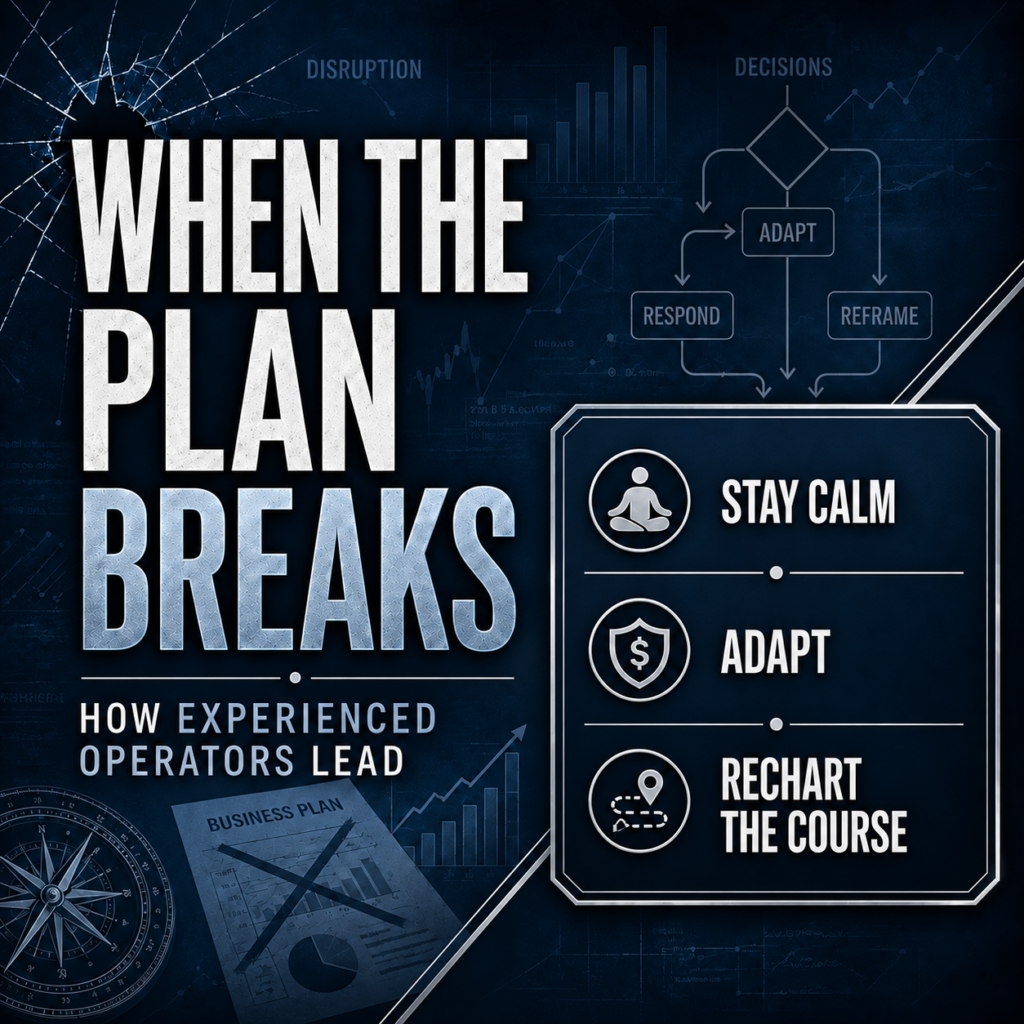
I have never seen a business plan unfold exactly the way it was written. Not once. You need the plan. You need the forecast. You need goals, budgets, timelines, and a clear destination. But if you build a company long enough, something will eventually happen that was not in the spreadsheet. A major customer leaves. A key employee quits. A deal falls apart. Financing changes. A competitor makes a move you did not expect. The market shifts. An acquisition develops problems. Revenue misses. Costs rise. Something breaks. That does not necessarily mean the plan was bad. It means you are running a business. After more than 30 years as an entrepreneur, I have learned that great operators are not the people who somehow avoid uncertainty. They are the people who remain effective when uncertainty arrives. Rule Number One: Don’t Panic This sounds simple. It is not. When a serious problem appears, your brain naturally wants to jump ahead. What happens if we lose the customer? What happens to cash? Are we going to miss payroll? What will the employees think? What happens to the deal? What happens next quarter? Those are legitimate questions. But panic rarely improves the answers, stick to the plan, stick to the process. The first responsibility of a leader is to separate the actual problem from the emotional reaction to the problem. Ask: What do we know? What do we think we know? What are we assuming? Those are three different things. Start with the facts. The CEO’s Reaction Becomes Part of the Problem When you lead a company, people watch you more closely than you realize. If you and your CFO disappear into an office for an hour and walk out looking terrified, people notice. They do not know what happened. So they create their own explanation. Something must be wrong. Layoffs are coming. We lost a customer. The company is struggling. Now the original business problem has created a second problem. Fear. Rumors. Distraction. Lower productivity. A leader does not need to pretend everything is wonderful. But leaders do need to understand that their behavior communicates constantly. Your team is asking: Do we have this under control? Sometimes the most important thing you can give them is confidence that the answer is yes, you have a plan. Get the Facts Before You Build the Story One of the easiest mistakes during a crisis is reacting to incomplete information. Sales are down. Why? Do not guess. Find out. A major customer is unhappy. Why? Talk to them. Margins changed. Where? Look at the numbers. A manager says the team is struggling. What specifically is happening? Get closer to the problem. Experienced operators learn to resist the temptation to immediately create a story around incomplete facts. Data first. Interpretation second. Decision third. That sequence matters. Bring in the Right People You do not have to solve every serious problem alone. In fact, that may be one of the worst times to try. Bring in the people whose experience matters. Your operator. Your CFO. Your attorney. Your industry expert. A trusted entrepreneur. Someone who has already survived something similar. This is where strong relationships become force multipliers. A problem that feels completely unfamiliar to you may be very familiar to someone else. They may recognize the pattern immediately. That does not mean they make the decision for you. It means you do not waste time rediscovering lessons that someone you trust has already learned. Protect Cash When business becomes uncertain, cash becomes oxygen. Growth can hide inefficiency. A downturn exposes it. When the numbers start moving in the wrong direction, understand your cash position quickly. How much runway do you have? What expenses are fixed? What can be reduced? What can be delayed? Where are you wasting money? What receivables can be collected faster? What commitments are approaching? Which activities are actually producing revenue? You do not have to slash everything. In fact, indiscriminate cost cutting can damage the business you are trying to protect. But leaders should know exactly where the money is going. When conditions change, financial visibility becomes critical. Protect the Things That Will Matter After the Storm There is a difference between cutting costs and cutting muscle. Be careful. The easiest things to eliminate are not always the things you should eliminate. Your best people. Customer experience. Training. Sales capability. Critical technology. The culture you spent years building. A business can become so focused on surviving the next three months that it destroys its ability to win during the next three years. You have to protect the core. Ask: What will we absolutely need when conditions improve? Protect that first. Do Not Fall in Love With the Original Plan Entrepreneurs need conviction. We also need flexibility. Those can exist at the same time. You can remain completely committed to the destination while changing the route. Maybe the original product changes. Maybe the market changes. Maybe the acquisition strategy changes. Maybe the capital structure changes. Maybe the timeline changes. Maybe the people change. That does not necessarily mean the vision failed. It may mean the route needs to be recalculated. One of the biggest mistakes entrepreneurs make is confusing persistence with rigidity. Persistence means continuing toward the goal. Rigidity means refusing to change how you get there. Those are very different. Know When the Problem Is Actually an Opportunity Some of the most important changes in business begin with something going wrong. A cost problem forces you to build a better operating system. A labor problem leads you toward automation. A difficult market exposes a better customer segment. A lost customer forces you to diversify. A failed acquisition teaches you exactly what to look for in the next one. A competitor forces you to improve faster. Adversity creates information. The question is whether you are paying attention. When something breaks, do not only ask: How do we fix this? Also ask: What is this teaching us? That second question can create enormous value.
Scaling vs Growing: The Mistake That Keeps Founders Owning a Job Instead of a Company
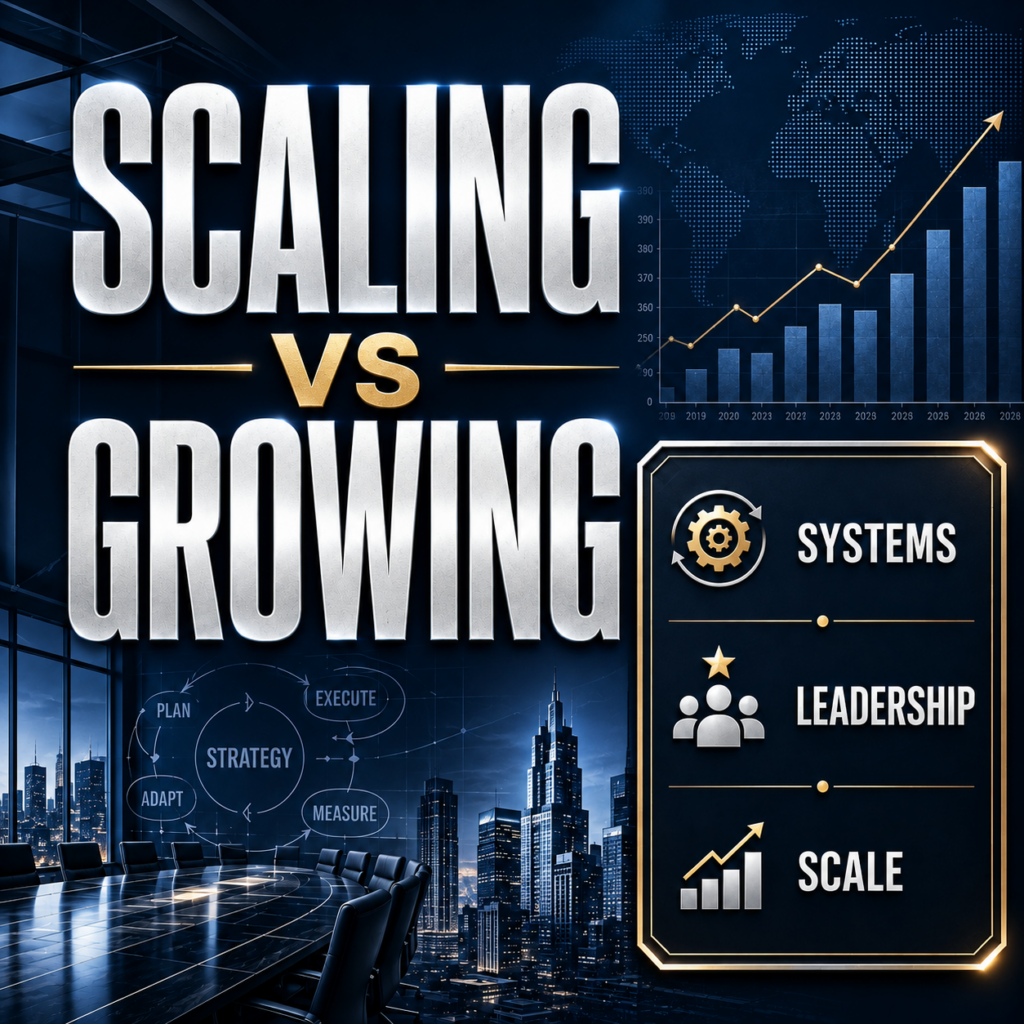
Every entrepreneur wants to grow. More customers. More revenue. More employees. More locations. More market share. But after more than 30 years building businesses, I have learned that growth and scale are two very different things. A company can grow rapidly and become harder to operate every month. Revenue goes up. Headcount goes up. Expenses go up. The founder works more hours. Everyone gets busier. And somehow the business becomes more dependent on the same handful of people who were already stretched thin. That is growth. It may be exciting. It may even be profitable. But it is not necessarily scale. Real scale happens when a business becomes capable of producing significantly more without requiring the founder, leadership team, or infrastructure to work proportionally harder every time the company gets bigger. That distinction matters. Because if doubling your revenue requires doubling your problems, doubling your management effort, and doubling the amount of time you personally spend holding everything together, you may be building a larger company without building a more scalable one. Growing a Business vs Scaling a Business Here is the simplest way I think about it. Growth means adding more. More people. More customers. More locations. More inventory. More revenue. Scaling means creating the capacity to handle more. Better systems. Stronger leaders. More visibility. Repeatable processes. Useful technology. A culture that can survive expansion. Growth is about size. Scale is about leverage. You need both. But when entrepreneurs pursue growth without first creating the infrastructure to support it, they usually end up scaling chaos. I Learned This the Expensive Way Earlier in my career, we managed large dispersed workforces the way many companies did at the time. We had layers of field management. Regional leaders. District managers. Territory managers. Trainers. People driving from location to location, checking stores, coaching employees, handing out materials, and moving on to the next stop. It worked. Until the business got large enough that I realized it was becoming extremely expensive and increasingly difficult to replicate. At one point, our travel and entertainment expense associated with that type of field structure exceeded $2 million annually. The obvious answer could have been to keep adding managers as the company grew. More employees require more supervisors. More locations require more field managers. More markets require more regional infrastructure. That would have grown the organization. Instead, we started asking a different question: How do we manage significantly more without building an equally large management organization around it? That question led us toward centralized management, virtual communication, real time training, better reporting, stronger analytics, and systems that gave leadership visibility into what was happening across the country. Eventually, the travel expense that had exceeded $2 million dropped below $200,000 while we gained more visibility and consistency across the operation. That is the difference between simply growing and learning how to scale. The Goal Is Repeatability One successful location proves you can operate one successful location. It does not prove you can operate 100. One great salesperson proves you hired a great salesperson. It does not prove you have a great sales organization. One strong manager proves that person can lead. It does not prove your leadership system works. Scaling is about turning individual success into repeatable organizational success. Can another location produce similar results? Can another salesperson learn the same process? Can another manager understand the standards? Can the customer receive a similar experience whether the founder is standing in the building or 1,500 miles away? If the answer is no, the business probably still depends too heavily on individuals rather than systems. Growth Exposes Everything Growth has a funny way of finding every weakness inside a company. A communication problem that is manageable with 10 employees becomes a serious problem with 100. A loose accounting process becomes dangerous when transaction volume multiplies. A mediocre manager becomes much more expensive when they are suddenly responsible for 30 people. A training problem that affects one location becomes a brand problem across 50 locations. A founder making every important decision becomes an organizational traffic jam. This is why I believe you need to build infrastructure slightly ahead of where the company is today. Not five years ahead. You can waste a lot of money building an organization for a future that has not arrived. But you need to be looking around the corner. What breaks if revenue doubles? What breaks if we add 100 employees? What breaks if we acquire a competitor? What breaks if we enter five new markets? What breaks if I disappear for two weeks? Those questions will tell you where the business needs to mature before the next stage of growth arrives. The Four Systems I Believe Every Scaling Company Needs Different industries require different infrastructure, but there are four areas I consistently look at when evaluating whether a company can scale. 1. Visibility You cannot effectively manage what you cannot see. As businesses become larger, founders naturally become further removed from individual transactions. That is unavoidable. The question is whether information disappears with that distance. I want to know what is happening in the business. Sales. Margins. Customer experience. Labor. Productivity. Conversion. Performance by location. Performance by individual. Performance against yesterday, last week, last month, and last year. When we were operating a large number of retail locations, centralized reporting gave us the ability to see performance across the organization rather than waiting for someone to visit a store and tell us what happened. Good data gives leaders the ability to manage exceptions instead of chasing information. You do not need to personally watch everything. You need a system capable of telling you where your attention belongs. 2. Repeatable Training and Processes If every employee learns the job differently, you are going to get a different company every time you hire somebody. That becomes incredibly dangerous at scale. Training should answer: What does good look like? How do we serve the customer? How do we sell? How do we communicate? What happens when
Why Join a Mastermind Group If You Already Run the Company?

If you already run a successful company, why would you need a mastermind group? You make decisions every day. You have employees, executives, attorneys, accountants, vendors, investors, and probably more information available to you than you have time to process. So why add another group of people to the equation? Because the higher you climb, the fewer people around you are truly positioned to challenge you. That is one of the realities of leadership that I have come to appreciate after more than 30 years as an entrepreneur. As the company grows, your responsibility increases. The decisions become more expensive. The number of people affected by those decisions gets larger. At the same time, the number of people willing and qualified to look you in the eye and tell you that you may be wrong usually gets smaller. That is where the right mastermind group becomes valuable. Not because you need another meeting on your calendar, but because you need to surround yourself with the right people! What Is a Mastermind Group? A mastermind group is a curated group of people who bring their experience, perspective, relationships, and expertise together to help one another make better decisions and accomplish bigger goals. The word curated matters. Putting ten entrepreneurs in a room does not automatically create a mastermind. The value comes from who is there, what they have experienced, how willing they are to contribute, and whether enough trust exists for people to discuss what is actually happening inside their businesses. The best mastermind groups are not built around everyone agreeing. They are built around everyone contributing. Sometimes that means an introduction. Sometimes it means an idea. Sometimes it means somebody recognizing a problem because they lived through the exact same situation five years earlier. And sometimes the most valuable contribution is somebody saying: I don’t think you should do that. Learning from other people’s mistakes can save you money and time! The CEO Has an Information Problem Most CEOs are surrounded by information. That does not necessarily mean they are surrounded by perspective. Your employees can give you information about the business, but there will always be a natural hierarchy involved. Your vendors have expertise, but they also have a commercial relationship with you. Your investors may have tremendous insight, but they view the company through a particular lens. Your friends and family can know you better than anyone, but they may not understand the decisions involved in scaling a company. Even a talented executive team operates inside the same company you do. Sometimes you need someone standing completely outside the jar to read the label. That is one of the great advantages of a strong mastermind group for entrepreneurs. Someone with no emotional attachment to your existing strategy can ask a very simple question that everyone inside the company stopped asking years ago. Why are you still doing it this way? Good questions create clarity. Great questions can change companies. Experience Compresses Time One of the most valuable things another entrepreneur can give you is not advice. It is pattern recognition. There is a tremendous difference between understanding something theoretically and having lived through it. If you are evaluating an acquisition for the first time, somebody who has completed 30 acquisitions is going to see things differently. If you are preparing to raise capital for the first time, someone who has already raised multiple rounds understands where the problems tend to appear. If your company is growing from 20 employees to 200, another CEO who has already navigated that transition may recognize organizational problems before you do. They are not necessarily smarter than you. They have simply seen that movie before. That is one reason I believe experience can become a force multiplier. A problem that might take you six months to identify can sometimes be recognized by someone else in ten minutes because they have already lived through it. You still have to make the decision. You still have to execute. But there is no prize in entrepreneurship for learning every lesson the expensive way. Why Employees Cannot Always Give a CEO What Peers Can A strong executive team is invaluable! I have been fortunate throughout my career to work alongside talented people whose strengths complement my own. But even with a great team, peer relationships serve a different purpose. Your employees ultimately need you to lead. They may challenge you, and the good ones absolutely should, but there are conversations CEOs have that carry a different weight when they happen with another person who has also: Made payroll. Signed personally on the loan. Had an acquisition go sideways. Lost a major customer. Hired the wrong executive. Negotiated with a company ten times their size. Had hundreds of families relying on the decisions being made that week. There is a certain shorthand between people who have carried similar responsibility. You do not have to spend an hour explaining why the decision matters. They already know. That matters when you need clarity quickly. A Mastermind Is Not a Networking Event This is where I think people sometimes misunderstand the concept. A mastermind should not simply be a networking mixer with better branding. It should not be a room where everyone walks around collecting business cards. It should not be one person talking from a stage while everyone else takes notes. It should not be an expensive webinar followed by access to a group chat. And it definitely should not be a room filled with people waiting for their turn to sell something. Networking can be useful. Education can be useful. Conferences can be useful. Coaching can be useful. But those are different products. A real mastermind works when qualified people bring real opportunities, real experiences, and real problems into an environment where everyone is expected to contribute. If everyone comes to consume, the model breaks. Why the Quality of the Group Matters So Much I would rather be in a room with eight extraordinary people than eighty people who simply paid to get through
Simple Scales: Why Simple Business Models Win at Scale
Simple Business Models: The Foundation of Scalable Success Simple Business Models are often overlooked in a world that celebrates complexity, innovation, and disruption. Many entrepreneurs believe that the more sophisticated their business is, the more valuable it becomes. In reality, the opposite is often true. The businesses that scale the fastest, operate the most efficiently, and generate the most consistent results are built on Simple Business Models. They are easy to understand, easy to execute, and—most importantly—easy to replicate. Jimmy Ralph has spent decades building and scaling companies across multiple industries, and one principle consistently stands out: simplicity wins. Not because it’s easy—but because it works. The Myth of Complexity in Business There’s a common belief in entrepreneurship that complexity equals value. More products, more services, more moving parts—it feels like growth. But complexity creates friction. Complex businesses are harder to: On the other hand, Simple Business Models remove friction. They allow leaders to focus on execution instead of constantly solving operational inefficiencies. The goal is not to build something complicated. The goal is to build something that works—repeatedly. Why Simple Business Models Scale Faster Scaling a business is not about doing something once. It’s about doing the same thing consistently, across different locations, teams, and markets. That’s where Simple Business Models create an advantage. When your model is simple: A complex model may work in one location. A simple model can work in hundreds. That’s the difference between a business and a scalable business. Understanding the Power of Unit Economics At the core of all Simple Business Models is one thing: clear unit economics. Great operators break their business down to its simplest form: When you understand these numbers, everything becomes clearer. You don’t need a complicated strategy. You need a repeatable formula. For example, if a single unit produces consistent profit, the path to growth becomes obvious—replicate that unit at scale. That’s how Simple Business Models turn into large businesses. Simple Doesn’t Mean Easy One of the biggest misconceptions about Simple Business Models is that they are easy to execute. They’re not. In fact, simple models often require more discipline because there’s nowhere to hide. Every inefficiency, every mistake, every breakdown becomes visible. Execution becomes the differentiator. Scaling a simple model across: …requires systems, training, accountability, and relentless consistency. The model may be simple. The execution is not. Building Systems Around Simplicity To make Simple Business Models work at scale, you need systems that support them. This includes: Jimmy Ralph’s approach to scaling businesses has always involved building infrastructure that reinforces simplicity. The goal is to create an environment where every employee knows exactly what to do—and how to do it well. When systems are aligned with a simple model, scale becomes achievable. Why Simplicity Improves Decision-Making Another advantage of Simple Business Models is clarity. When your business is easy to understand, decisions become easier to make. You can quickly answer: Complex businesses often struggle with these questions because there are too many variables. Simple businesses can move faster because the path forward is clearer. In competitive markets, speed matters. Simplicity creates speed. How to Simplify Your Business If you want to leverage Simple Business Models, the first step is to strip your business down to its core components. Ask yourself: Most businesses don’t need to add more—they need to remove more. Simplification leads to clarity. Clarity leads to better execution. The Role of Environment in Refining Simplicity Simplifying a business is not always easy when you’re operating inside it every day. That’s where environment becomes critical. When you’re surrounded by other experienced operators, you gain perspective. You see how others structure their businesses, where they eliminate inefficiencies, and how they scale effectively. Being part of a CEO community like Board of Advisors provides that exposure. It allows leaders to refine their approach, challenge assumptions, and identify ways to simplify faster. Simple Business Models are often the result of experience, collaboration, and continuous improvement. Why Simple Business Models Win Long-Term At the highest level, business success is not about complexity—it’s about consistency. The companies that win over time are the ones that: All of this is easier to achieve with Simple Business Models. They create alignment across teams. They reduce operational risk. They allow leaders to focus on growth instead of constantly fixing problems. And over time, that consistency compounds into significant competitive advantage. Final Thought If you’re trying to scale your business, don’t start by adding more. Start by simplifying. The most successful operators understand that Simple Business Models are not a limitation—they are a strength. They create clarity, enable execution, and make scale possible. Because in the end, the businesses that grow the largest are not the most complicated. They’re the most repeatable. Lived By: Jimmy RalphCEO Board of Advisors Interesting in joining the BA Community? bainvite.com Want to stay up to date with Jimmy Ralph?Follow Jimmy on LinkedIn | X (formerly Twitter) | YouTube | Instagram | Facebook for leadership insights, business lessons, behind-the-scenes updates, and more! Visit Board of Advisors website Board of Advisors magazine | Board of Advisors X | Board of Advisors Youtube | Board of Advisors Instagram Shameless Plug time: If you’re in the St. Pete/Tampa area and are in need of drone/video filming services then check out my nephew’s company HR Video & Drone!
Building Your Personal Brand: Why It Matters and How to Do It Right

Building Your Personal Brand: Why It’s a Business Asset, Not a Vanity Play Building Your Personal Brand is no longer optional for entrepreneurs, CEOs, and operators—it’s a strategic advantage. Yet many leaders still treat it like a side project or avoid it altogether. The reality is simple: people do business with people. And in today’s environment, your reputation is often formed long before you ever enter a room. When done correctly, Building Your Personal Brand becomes a force multiplier for your business. It attracts opportunities, builds credibility, and creates leverage that extends far beyond traditional marketing. Jimmy Ralph’s career has been built on execution, leadership, and scaling businesses. As he continues to expand his influence, one thing is clear—your personal brand is not separate from your business. It is a direct extension of it. Why Building Your Personal Brand Matters for Growth At its core, Building Your Personal Brand is about positioning. It defines how the market perceives you, what you stand for, and why people should trust you. A strong personal brand attracts: Without it, you’re relying solely on your business to create visibility. With it, you become a recognized authority—someone people seek out rather than overlook. The leaders who understand Building Your Personal Brand don’t just grow companies—they build influence that compounds over time. What Your Personal Brand Should Represent One of the biggest mistakes people make when Building Your Personal Brand is trying to be everything to everyone. Strong brands are clear, consistent, and focused. For a leader like Jimmy Ralph, the brand is built around: Your personal brand should reflect your real strengths—not a version of yourself you think the market wants. When Building Your Personal Brand, ask yourself: Clarity in these areas creates consistency—and consistency builds trust. How to Start Building Your Personal Brand There’s no shortage of advice on Building Your Personal Brand, but most of it lacks practical application. The key is to focus on execution, not perfection. Here’s how to approach it: 1. Choose Your Core Platforms Not every platform matters equally. For business leaders, the focus should be on: Consistency on a few platforms beats inconsistency across many. 2. Share Real Insights, Not Generic Advice The fastest way to fail at Building Your Personal Brand is by posting surface-level content. People don’t follow leaders for clichés—they follow them for perspective. Share: Substance builds credibility. 3. Document, Don’t Manufacture You don’t need to create a persona. The most effective approach to Building Your Personal Brand is documenting what you’re already doing. Turn real experiences into content. This keeps your brand authentic and sustainable. 4. Stay Consistent Over Time Consistency is where most people fail. Building Your Personal Brand is not about going viral once—it’s about showing up repeatedly with valuable insights. The leaders who win in this space are the ones who: Over time, consistency compounds into authority. Aligning Your Personal Brand with Business Outcomes A common mistake in Building Your Personal Brand is separating it from business objectives. Your brand should drive real outcomes: Everything you share should reinforce your positioning as a leader in your space. When aligned correctly, Building Your Personal Brand becomes a growth channel—not just a communication tool. Mistakes to Avoid When Building Your Personal Brand There are a few patterns that consistently hold people back: Inconsistency Posting sporadically or changing your message frequently weakens your brand. Lack of Clarity If people don’t know what you stand for, they won’t remember you. Overproduction Without Substance High-quality visuals don’t replace meaningful insights. Trying to Appeal to Everyone Strong brands attract the right audience—not everyone. Avoiding these mistakes is just as important as executing the right strategy when Building Your Personal Brand. The Role of Environment in Accelerating Your Brand Your environment plays a significant role in Building Your Personal Brand. When you surround yourself with high-level operators, your thinking sharpens. Your content improves. Your perspective expands. Being part of a CEO community like Board of Advisors accelerates this process. It provides: This environment naturally strengthens your brand because you’re constantly learning and evolving. Personal Brand as a Long-Term Asset The most important thing to understand about Building Your Personal Brand is that it compounds. Every post, every insight, every interaction contributes to a larger narrative. Over time, that narrative becomes your reputation. And reputation drives opportunity. Leaders who invest in Building Your Personal Brand today position themselves for: It’s not about immediate results—it’s about sustained impact. Final Thought In today’s business landscape, visibility matters. Credibility matters. Trust matters. And all three are shaped by your personal brand. If you approach Building Your Personal Brand with the same discipline you apply to your business—focused, consistent, and value-driven—you create something far more powerful than content. You create leverage. And leverage is what allows great leaders to scale not just their companies, but their impact. Lived By: Jimmy RalphCEO – More Cubed Want to stay up to date with Jimmy Ralph?Follow Jimmy on LinkedIn | X (formerly Twitter) | YouTube | Instagram | Facebook for leadership insights, business lessons, behind-the-scenes updates, and more! Shameless Plug time: If you’re in the St. Pete/Tampa area and need video/drone film services, check out my nephew’s company HR Video and Drone!
Trusting Your Team: The Leadership Skill That Unlocks Real Scale
Trusting Your Team: Why It’s the Foundation of Scalable Leadership Trusting Your Team is one of the most critical—and most misunderstood—skills in business leadership. Many leaders say they trust their team, but their actions tell a different story. They micromanage decisions, double-check every task, and struggle to let go of control. The reality is simple: if you can’t trust your team, you can’t scale your business. At a certain point, growth demands delegation. And delegation requires trust. Jimmy Ralph has built organizations with hundreds of locations and thousands of employees, and one principle is clear—Trusting Your Team is not optional at scale. It’s the foundation that everything else is built on. Why Trusting Your Team Is Required for Growth In the early stages of a business, leaders are involved in everything. They make every decision, solve every problem, and often carry the entire operation themselves. But that model breaks quickly. As a company grows, complexity increases. More employees, more locations, more moving parts. If leadership tries to maintain control over every detail, the organization slows down—and eventually stalls. Trusting Your Team allows leaders to: Without trust, growth becomes friction. With trust, growth becomes momentum. Trust Is Built Through Systems, Not Just Intentions One of the biggest misconceptions about Trusting Your Team is that it’s purely emotional. In reality, trust in business is built through structure. High-performing organizations don’t rely on blind trust. They build systems that support it. Jimmy Ralph’s approach to scaling businesses has always been rooted in visibility and accountability. Through centralized management systems and real-time data, leaders can understand exactly what’s happening across the organization without being physically present. This creates a powerful dynamic: Trusting Your Team becomes easier when you’ve built an environment where expectations are clear and performance is measurable. Hiring for Trust: It Starts with the Right People You cannot build trust with the wrong team. One of the most important aspects of Trusting Your Team is hiring individuals who align with your standards, your culture, and your expectations. Skill matters—but reliability, accountability, and attitude matter just as much. Great leaders hire people who: When you hire correctly, trust becomes a natural extension of your team—not something you have to force. Coaching vs. Controlling: The Leadership Shift Many leaders struggle with Trusting Your Team because they confuse control with effectiveness. Control slows teams down. Coaching develops them. The best organizations operate with a coaching mindset: This approach creates stronger, more capable teams. Instead of relying on leadership for every decision, employees become confident operators who can execute independently. Trusting Your Team doesn’t mean stepping away—it means stepping into a different role. One that focuses on development, not control. Letting Go Without Losing Visibility One of the hardest parts of Trusting Your Team is learning how to let go without feeling disconnected. Many leaders worry that if they step back, they’ll lose control of the business. In reality, the opposite is true—if you don’t step back, you limit your ability to lead effectively. The key is balance: When done correctly, Trusting Your Team allows leaders to focus on growth, innovation, and long-term strategy—while the business continues to execute at a high level. The Cost of Not Trusting Your Team Failing to embrace Trusting Your Team comes with real consequences. Leaders who refuse to delegate often experience: Teams can feel it when they’re not trusted. It impacts morale, engagement, and performance. Over time, top talent leaves environments where they aren’t empowered to contribute. On the other hand, organizations built on trust tend to: The difference is significant—and it compounds over time. Why Trust Extends Beyond Your Organization Trusting Your Team doesn’t stop within your company. It extends to your network, your advisors, and your business relationships. No leader builds a successful company alone. The most effective operators surround themselves with people they trust—individuals who can provide perspective, challenge decisions, and offer strategic insight. This is where being part of a CEO community becomes powerful. When you’re consistently in a room with other high-level operators, you gain access to trusted perspectives that accelerate growth. Trust becomes a multiplier—not just internally, but externally as well. Trust Is What Turns Good Companies into Great Ones At its core, Trusting Your Team is about leadership maturity. Early-stage leaders feel the need to control everything. Experienced leaders understand that real success comes from building systems, developing people, and creating an environment where others can execute at a high level. Trust doesn’t mean lowering standards. It means raising them—and giving your team the structure and support to meet them. Final Thought If you want to scale your business, you have to make a shift. You have to move from doing everything yourself to building a team that can operate without you. That requires Trusting Your Team. When you get it right, everything changes. The business moves faster. The team gets stronger. And you, as a leader, can finally focus on what matters most—growth, strategy, and building something that lasts. Lived By: Jimmy RalphPresident & CEO, Board of Advisors Interesting in joining the BA Community? bainvite.com Want to stay up to date with Jimmy Ralph?Follow Jimmy on LinkedIn | X (formerly Twitter) | YouTube | Instagram | Facebook for leadership insights, business lessons, behind-the-scenes updates, and more! Visit Board of Advisors website Board of Advisors magazine | Board of Advisors X | Board of Advisors Youtube | Board of Advisors Instagram
The Power of Positive Thinking in Business: Why Mindset Drives Results

Power of Positive Thinking in Business: Why It Matters More Than You Think The Power of Positive Thinking in Business is often misunderstood. Too many people associate it with blind optimism or motivational clichés. In reality, it’s neither. For high-level operators, founders, and CEOs, positive thinking is not about ignoring problems—it’s about controlling how you respond to them. Every business faces pressure. Deals fall apart. Employees leave. Competitors emerge. Markets shift. The difference between companies that scale and those that stall often comes down to one thing: leadership mindset. Jimmy Ralph has built and scaled multiple companies over decades, and one consistent principle shows up in everything he does—leaders must maintain control of the narrative, especially when things get difficult. That’s where the Power of Positive Thinking in Business becomes a tactical advantage, not just a philosophy. Why the Power of Positive Thinking in Business Starts at the Top Leadership sets the emotional tone of an organization. Whether you realize it or not, your team is constantly reading your reactions, your body language, and your energy. If you walk out of a tough meeting looking defeated, your team notices. If you hesitate in decision-making, your team feels it. And when uncertainty creeps into leadership, it spreads quickly across the organization. The Power of Positive Thinking in Business is about maintaining composure and clarity—even when the situation doesn’t warrant it. That doesn’t mean pretending everything is perfect. It means choosing to lead with confidence while solving real problems behind the scenes. Great leaders understand that their mindset is not just personal—it’s operational. It directly impacts productivity, morale, and execution across the business. Controlling the Narrative, Not Ignoring Reality There’s a critical distinction to make. Positive thinking is not about ignoring challenges. It’s about controlling the narrative around them. Every business will face adversity. That’s not a possibility—it’s a guarantee. Competitors will make moves. Key employees may leave. Financial pressure will show up at the worst possible times. The Power of Positive Thinking in Business comes from understanding that while you cannot control every outcome, you can control your response. Instead of reacting emotionally, strong leaders reframe: This mindset allows leaders to stay focused on solutions instead of getting stuck in reaction mode. How Mindset Directly Impacts Business Performance Mindset is not abstract. It has very real, measurable consequences inside a business. When leadership operates from a negative or reactive mindset: On the other hand, when leaders consistently apply the Power of Positive Thinking in Business, the opposite happens: It’s not about being overly optimistic—it’s about being steady. Consistent. Reliable under pressure. That stability becomes a competitive advantage. Practical Ways to Apply the Power of Positive Thinking in Business This is where most people get it wrong. They understand the concept, but they don’t operationalize it. Here’s how the Power of Positive Thinking in Business shows up in real execution: 1. Control Your Immediate Reaction When something goes wrong, your first reaction matters.Train yourself to pause before responding.Emotion is natural—reaction is a choice. 2. Reframe the Situation Quickly Ask: This shifts your brain from problem-focused to solution-focused. 3. Protect Your Team from Unnecessary Noise Not every issue needs to be broadcast internally.Leaders absorb pressure so teams can stay focused on execution. 4. Stay Consistent in Communication Consistency builds trust.Your team should never feel like they’re guessing how you’ll respond. 5. Build a Routine That Reinforces Mental Strength Whether it’s early mornings, structured planning, or physical discipline, high performers build routines that support clarity and resilience. The Power of Positive Thinking in Business is not a one-time decision—it’s a daily discipline. Why the Right Environment Reinforces the Right Mindset Even the strongest leaders need reinforcement. That’s where environment becomes critical. Surrounding yourself with other high-level operators changes your perspective. It keeps you grounded, focused, and aligned. When you’re in a room with people who are solving real problems and building real businesses, your mindset naturally elevates. That’s one of the core advantages of being part of a CEO community like Board of Advisors. You’re not operating in isolation. You’re constantly exposed to new ideas, new strategies, and new ways of thinking. The Power of Positive Thinking in Business becomes easier to maintain when you’re consistently in the right rooms. Positive Thinking Is a Competitive Advantage At the highest level, business is not just about strategy, capital, or execution. It’s about leadership. And leadership starts with mindset. The Power of Positive Thinking in Business is what allows leaders to: It’s not about being unrealistic. It’s about being disciplined in how you think, how you respond, and how you lead. Because in business, the leaders who maintain control of their mindset are the ones who ultimately control the outcome. Final Thought Every business will face adversity. That’s part of the game. The difference is how you respond. If you can master the Power of Positive Thinking in Business, you give yourself—and your organization—a significant edge. You create stability in chaos. Clarity in uncertainty. And momentum when others hesitate. And over time, that compounds into something far more powerful than motivation. It becomes results. Lived By: Jimmy RalphPresident & CEO, Board of Advisors Interesting in joining the BA Community? bainvite.com Want to stay up to date with Jimmy Ralph?Follow Jimmy on LinkedIn | X (formerly Twitter) | YouTube | Instagram | Facebook for leadership insights, business lessons, behind-the-scenes updates, and more! Visit Board of Advisors website Board of Advisors magazine | Board of Advisors X | Board of Advisors Youtube | Board of Advisors Instagram
