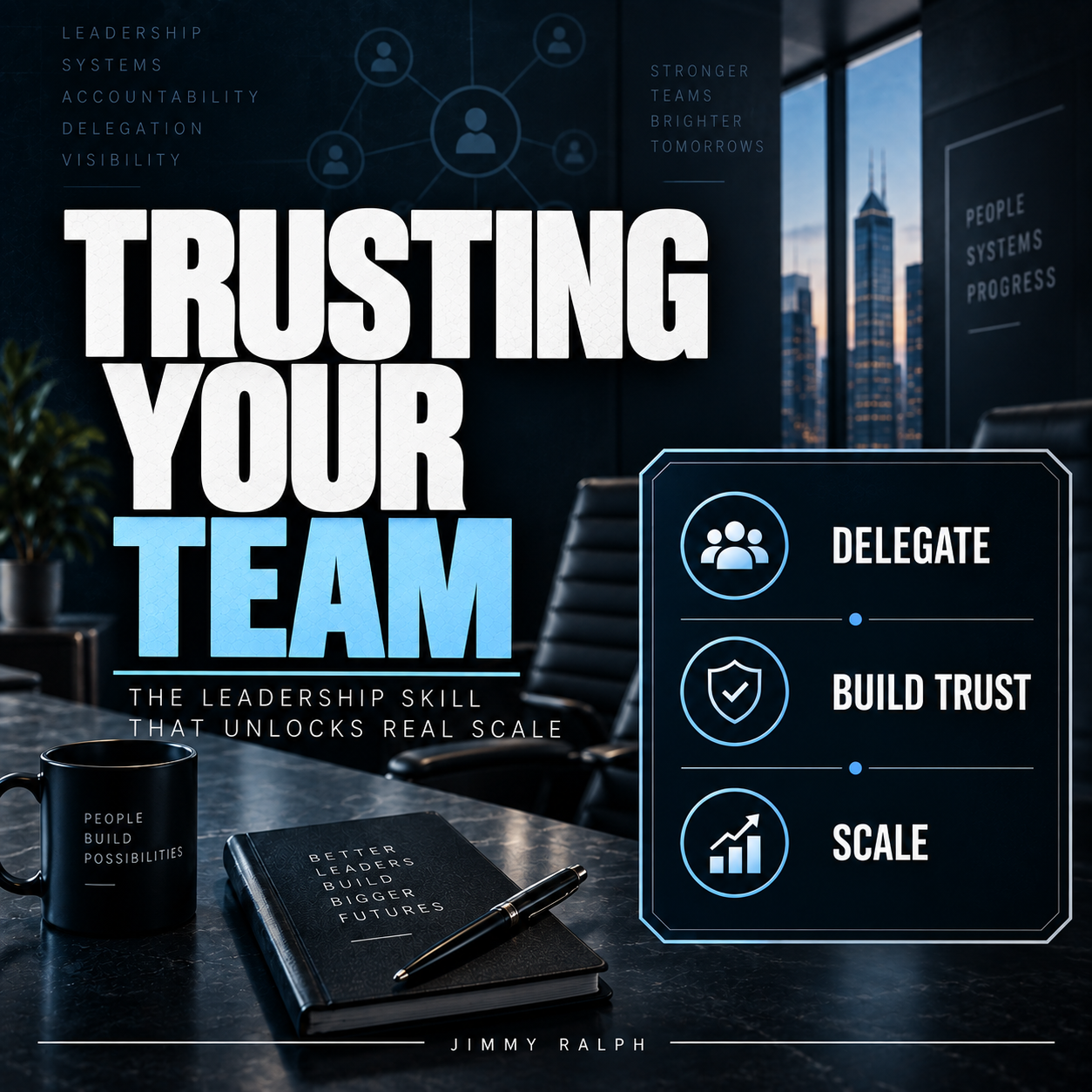
Trusting Your Team: Why It’s the Foundation of Scalable Leadership
Trusting Your Team is one of the most critical—and most misunderstood—skills in business leadership. Many leaders say they trust their team, but their actions tell a different story. They micromanage decisions, double-check every task, and struggle to let go of control.
The reality is simple: if you can’t trust your team, you can’t scale your business.
At a certain point, growth demands delegation. And delegation requires trust. Jimmy Ralph has built organizations with hundreds of locations and thousands of employees, and one principle is clear—Trusting Your Team is not optional at scale. It’s the foundation that everything else is built on.
Why Trusting Your Team Is Required for Growth
In the early stages of a business, leaders are involved in everything. They make every decision, solve every problem, and often carry the entire operation themselves.
But that model breaks quickly.
As a company grows, complexity increases. More employees, more locations, more moving parts. If leadership tries to maintain control over every detail, the organization slows down—and eventually stalls.
Trusting Your Team allows leaders to:
- Move faster
- Focus on higher-level strategy
- Empower decision-making across the organization
- Scale operations without bottlenecks
Without trust, growth becomes friction. With trust, growth becomes momentum.
Trust Is Built Through Systems, Not Just Intentions
One of the biggest misconceptions about Trusting Your Team is that it’s purely emotional. In reality, trust in business is built through structure.
High-performing organizations don’t rely on blind trust. They build systems that support it.
Jimmy Ralph’s approach to scaling businesses has always been rooted in visibility and accountability. Through centralized management systems and real-time data, leaders can understand exactly what’s happening across the organization without being physically present.
This creates a powerful dynamic:
- Teams feel empowered to act
- Leaders maintain visibility into performance
- Trust is reinforced through data, not guesswork
Trusting Your Team becomes easier when you’ve built an environment where expectations are clear and performance is measurable.
Hiring for Trust: It Starts with the Right People
You cannot build trust with the wrong team.
One of the most important aspects of Trusting Your Team is hiring individuals who align with your standards, your culture, and your expectations. Skill matters—but reliability, accountability, and attitude matter just as much.
Great leaders hire people who:
- Take ownership of their role
- Communicate clearly and consistently
- Execute without constant oversight
- Represent the company the right way
When you hire correctly, trust becomes a natural extension of your team—not something you have to force.
Coaching vs. Controlling: The Leadership Shift
Many leaders struggle with Trusting Your Team because they confuse control with effectiveness.
Control slows teams down. Coaching develops them.
The best organizations operate with a coaching mindset:
- Leaders guide, not dictate
- Feedback is continuous, not occasional
- Performance is improved in real time
This approach creates stronger, more capable teams. Instead of relying on leadership for every decision, employees become confident operators who can execute independently.
Trusting Your Team doesn’t mean stepping away—it means stepping into a different role. One that focuses on development, not control.
Letting Go Without Losing Visibility
One of the hardest parts of Trusting Your Team is learning how to let go without feeling disconnected.
Many leaders worry that if they step back, they’ll lose control of the business. In reality, the opposite is true—if you don’t step back, you limit your ability to lead effectively.
The key is balance:
- Maintain visibility through reporting and communication
- Set clear expectations and measurable goals
- Stay involved at a strategic level, not an operational level
When done correctly, Trusting Your Team allows leaders to focus on growth, innovation, and long-term strategy—while the business continues to execute at a high level.
The Cost of Not Trusting Your Team
Failing to embrace Trusting Your Team comes with real consequences.
Leaders who refuse to delegate often experience:
- Burnout
- Slower decision-making
- Limited scalability
- Frustrated employees
Teams can feel it when they’re not trusted. It impacts morale, engagement, and performance. Over time, top talent leaves environments where they aren’t empowered to contribute.
On the other hand, organizations built on trust tend to:
- Retain high-performing employees
- Move faster than competitors
- Adapt more quickly to change
- Create stronger internal cultures
The difference is significant—and it compounds over time.
Why Trust Extends Beyond Your Organization
Trusting Your Team doesn’t stop within your company. It extends to your network, your advisors, and your business relationships.
No leader builds a successful company alone. The most effective operators surround themselves with people they trust—individuals who can provide perspective, challenge decisions, and offer strategic insight.
This is where being part of a CEO community becomes powerful. When you’re consistently in a room with other high-level operators, you gain access to trusted perspectives that accelerate growth.
Trust becomes a multiplier—not just internally, but externally as well.
Trust Is What Turns Good Companies into Great Ones
At its core, Trusting Your Team is about leadership maturity.
Early-stage leaders feel the need to control everything. Experienced leaders understand that real success comes from building systems, developing people, and creating an environment where others can execute at a high level.
Trust doesn’t mean lowering standards. It means raising them—and giving your team the structure and support to meet them.
Final Thought
If you want to scale your business, you have to make a shift.
You have to move from doing everything yourself to building a team that can operate without you.
That requires Trusting Your Team.
When you get it right, everything changes. The business moves faster. The team gets stronger. And you, as a leader, can finally focus on what matters most—growth, strategy, and building something that lasts.
Lived By: Jimmy Ralph
President & CEO, Board of Advisors
Interesting in joining the BA Community? bainvite.com
Want to stay up to date with Jimmy Ralph?
Follow Jimmy on LinkedIn | X (formerly Twitter) | YouTube | Instagram | Facebook for leadership insights, business lessons, behind-the-scenes updates, and more!
Visit Board of Advisors website
Board of Advisors magazine | Board of Advisors X | Board of Advisors Youtube | Board of Advisors Instagram