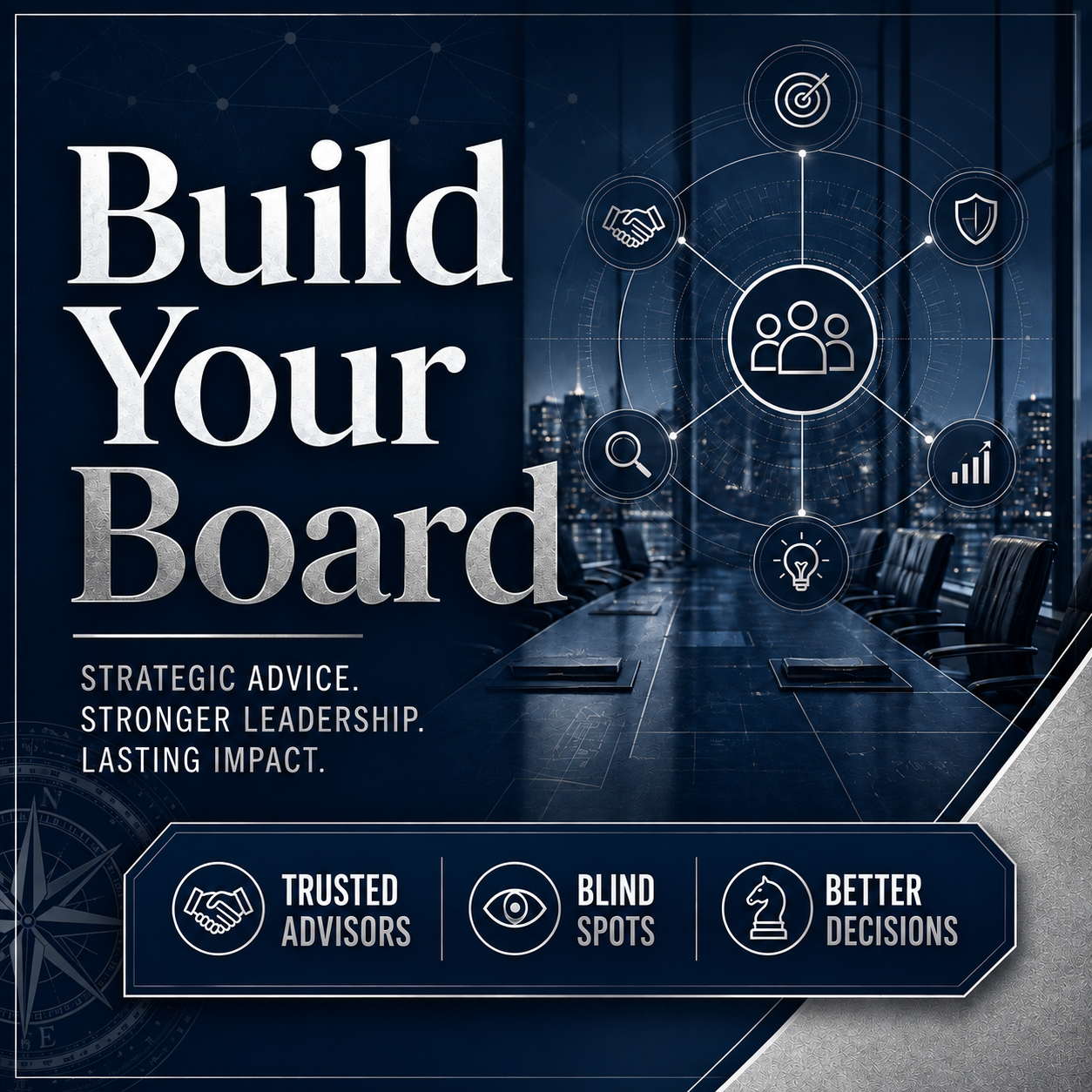
Most entrepreneurs eventually build a team inside their company.
A salesperson.
An accountant.
An attorney.
Managers.
Executives.
Maybe investors.
But there is another group every serious entrepreneur should build intentionally:
Your personal board of advisors.
I am not talking about a legal board of directors.
I am talking about trusted people you can call when the decision is important, the answer is unclear, or the situation falls outside your experience.
People who understand different parts of business.
People who have already traveled roads you are just beginning to walk.
People who will challenge you.
People who will answer the phone.
And most importantly, people who do not need to agree with you.
After more than 30 years in business, I believe one of the greatest advantages a CEO can create is access to the right people before they are needed.
You do not want to start looking for the right advisor after the problem becomes an emergency.
What Is a Personal Board of Advisors?
A personal board of advisors is an informal group of trusted people whose collective experience helps you make better decisions.
There does not need to be a conference table.
There does not need to be a quarterly meeting.
They may never all be in the same room.
One might be an entrepreneur.
One might be an attorney.
One might understand capital.
One might be an exceptional operator.
Another might simply know you well enough to tell you when your judgment is being clouded by emotion or ego.
What matters is that they expand what you are capable of seeing.
You Cannot Be Great at Everything
Entrepreneurs tend to be confident.
We have to be.
Building a company requires making decisions before the answer is obvious.
But confidence becomes dangerous when it turns into the belief that the CEO should personally be great at everything.
You cannot be.
Neither can I.
You may be great at sales and weak in finance.
You may understand finance but struggle with people.
You may be a strong operator without being a visionary.
You may know your product better than anyone and know very little about raising capital.
There is nothing wrong with that.
The mistake is pretending the gaps do not exist.
One of the most important lessons I have learned is to understand where I create the most value and surround myself with people who are exceptional where I am not.
Start With Your Blind Spots
Do not begin by asking:
Who are the most impressive people I know?
Ask:
Where am I most vulnerable?
Look at the major areas of your business:
Finance.
Operations.
Sales.
Marketing.
Legal.
Capital.
Technology.
People.
Strategy.
Negotiation.
Acquisitions.
Leadership.
Where are you strong?
Where are you competent?
Where are you making decisions that exceed your experience?
Those gaps tell you where relationships need to be built.
Your board should not be a collection of people who resemble you.
It should be a collection of people who expand you.
The Operator
Every visionary needs access to someone who understands execution.
Ideas are exciting.
Execution builds companies.
A great operator asks:
Who owns this?
What happens first?
Where will this break?
Who needs to be hired?
How do we measure it?
What does this look like at ten times the volume?
Entrepreneurs often think in possibilities.
Operators turn possibilities into reality.
If you are naturally a visionary, an exceptional operator can be one of the strongest force multipliers in your career.
The Financial Mind
Entrepreneurs naturally see opportunity.
A strong financial mind sees the opportunity and the structure underneath it.
Can we afford it?
How should we finance it?
What happens to cash?
What is the downside?
Which assumptions are carrying the model?
What happens if revenue misses plan?
The purpose of a strong financial advisor is not to kill entrepreneurial ideas.
It is to help make ambitious ideas sustainable.
The entrepreneur asks:
How do we make this happen?
The right financial person helps answer:
How do we make this happen responsibly?
The Legal Mind
Most entrepreneurs focus on the upside.
Attorneys are trained to think about what happens when things do not go according to plan.
Contracts.
Liability.
Employment issues.
Intellectual property.
Partnership structures.
Acquisitions.
Regulatory exposure.
Litigation.
You do not need legal advice on every decision.
But you want a trusted legal relationship established before the deal is closing or the lawsuit arrives.
Build that relationship early.
The Capital Person
Growth eventually becomes a capital allocation problem.
Maybe you need debt.
Maybe equity.
Maybe a strategic partner.
Maybe the smartest answer is not raising money at all.
Someone who understands capital can help you think beyond simply getting the money.
What does it cost?
What did you give up?
What expectations came with it?
What restrictions exist?
What does the structure allow you to do next?
Money can be a force multiplier.
The wrong money can become an anchor.
Know people who understand the difference.
The Connector
Some people are exceptional at connecting the right people.
You explain a problem and they immediately say:
You need to talk to this person.
Great connectors are valuable because they understand context.
One introduction can create:
A customer.
An executive hire.
An investor.
A partnership.
An acquisition.
A vendor.
A lifelong relationship.
Sometimes one introduction changes the trajectory of a company.
Never underestimate someone who knows how to put the right people together.
The Experienced Entrepreneur
Some things are difficult to understand until you have lived them.
Making payroll when cash is tight.
Losing a major client.
Buying another company.
Selling one.
Getting sued.
Firing a senior executive.
Managing explosive growth.
Leading through a downturn.
Walking into a negotiation knowing millions are at stake.
An experienced entrepreneur may not understand your exact business.
They understand the weight of the decision.
Experience creates pattern recognition.
Pattern recognition creates speed.
The Industry Expert and the Outsider
You need both.
The industry expert understands the rules of your market.
Customers.
Pricing.
Regulation.
Distribution.
Competitive dynamics.
They can tell you why something that looks brilliant on paper may never work in the real world.
But you also need people outside your industry.
Industry experience creates expertise.
It can also create assumptions.
People begin saying:
That is just how this business works.
An outsider may ask:
Why?
Sometimes that question is where innovation begins.
Know people who understand your world deeply.
Also know people who are not trapped by it.
The Truth Teller
Every successful entrepreneur needs someone who is unimpressed by their success.
Someone who will say:
I think you’re wrong.
You’re making this emotional.
You’re avoiding the real problem.
You do not need another company.
Success creates an interesting problem.
Your title gets bigger.
Your company gets bigger.
The stakes get bigger.
And sometimes the number of people willing to challenge you gets smaller.
Protect the relationships with people who will tell you the truth.
Your Board Should Evolve
The people you need around a startup may not be the people you need around a $100 million company.
Early questions might involve:
Product.
Sales.
Customers.
Cash.
Hiring.
Later questions become:
Capital allocation.
Acquisitions.
Executive compensation.
Governance.
Risk.
Culture.
Succession.
Exit strategy.
Your relationships should evolve because your problems evolve.
Some people will grow alongside you for decades.
Others will enter your life because the next stage requires experience you do not yet have.
Do Not Chase Famous People
A great advisor does not need 10 million followers.
They do not need to be famous.
They do not need to have written a book.
They need to be:
Relevant.
Experienced.
Trustworthy.
Available.
The entrepreneur who quietly built and sold three companies may be far more valuable than someone with a huge personal brand who barely knows your name.
Do not build a board that looks impressive.
Build one that makes you better.
Build These Relationships Before You Need Them
Do not wait until:
You need money.
The acquisition appears.
The lawsuit arrives.
The executive quits.
The market turns.
The business suddenly doubles.
The strongest relationships are built when neither side desperately needs something.
Call people when things are good.
Have dinner.
Make introductions.
Share opportunities.
Help when you can.
Stay in touch.
Relationship equity compounds.
Then when something important happens, you are calling someone who already knows you.
There is trust.
There is context.
You can get directly to the problem.
That creates speed.
Advisors Do Not Make the Decision for You
A personal board of advisors does not remove responsibility from the CEO.
Your advisors provide perspective.
You still make the call.
You may ask five trusted people and receive five different answers.
That is fine.
The purpose is not to outsource judgment.
The purpose is to improve it.
Listen.
Ask questions.
Understand why people disagree.
Then decide.
Leadership means accepting responsibility for the final call.
Give Them the Real Problem
If you want useful advice, give people the truth.
Not the polished version.
Not the version designed to make the answer you already want sound obvious.
Give them:
The ugly numbers.
The concern you do not want to admit.
The decision you are struggling with.
The mistake you may have caused.
Good advisors cannot help solve a problem you refuse to show them.
If you trust someone enough to ask for their perspective, trust them enough to give them the full picture.
Be Worth Advising
This relationship goes both ways.
You cannot build a world class advisory network by constantly asking accomplished people to solve your problems while offering nothing in return.
Bring value.
Make introductions.
Share your expertise.
Support their projects.
Answer their call.
Follow through.
And when someone gives you advice, respect their time enough to seriously consider it.
Strong advisory relationships are relationships first.
Contribution matters.
Become a Force Multiplier for Others
If you want great people around you, become valuable to them too.
What are you exceptional at?
What experience do you have?
Who can you introduce?
What mistake have you already made that could save someone else time?
What problem can you help solve?
Some of the most important relationships in my career did not begin with:
What can this person do for me?
They developed because people found ways to create value for one another.
If you want force multipliers around you, become one.
Conduct Your Own Advisor Audit
Write down the names.
Who do you call for operations?
Who do you call for finance?
Who understands capital?
Who is your trusted legal mind?
Who understands your industry?
Who has built something substantially bigger than what you are building today?
Who thinks differently than you?
Who connects people?
Who tells you the truth?
Who answers when business gets difficult?
You may realize one person fills several roles.
You may also discover an important blank.
That is useful information.
Then ask the harder question:
Whose board would I belong on?
Because that tells you whether you are contributing as much relationship equity as you are trying to create.
The Right People Increase What You Can Build
When I look back over decades of entrepreneurship, I can see the people behind many of the decisions that mattered.
People whose abilities were different from mine.
People who challenged me.
People who helped execute.
People who understood things I did not.
That has never made me less capable as a CEO.
It has made me more capable.
A strong entrepreneur does not need every answer.
A strong entrepreneur needs to know how to find the answer, recognize the right people, and build relationships long before the answer becomes urgent.
Your personal board of advisors will not appear overnight.
You build it one conversation, one introduction, one shared challenge, and one act of trust at a time.
Years later, you may realize those relationships became some of the greatest force multipliers in your career.
Build them before you need them.
Because when the difficult decision arrives, having the right person already in your corner can change everything.
Lived By: Jimmy Ralph
CEO Board of Advisors
Interesting in joining the BA Community? bainvite.com
Want to stay up to date with Jimmy Ralph?
Follow Jimmy on LinkedIn | X (formerly Twitter) | YouTube | Instagram | Facebook for leadership insights, business lessons, behind-the-scenes updates, and more!
Visit Board of Advisors website
Board of Advisors magazine | Board of Advisors X | Board of Advisors Youtube | Board of Advisors Instagram
Shameless Plug time: If you’re in the St. Pete/Tampa area and need video/drone film services, check out my nephew’s company HR Video and Drone!