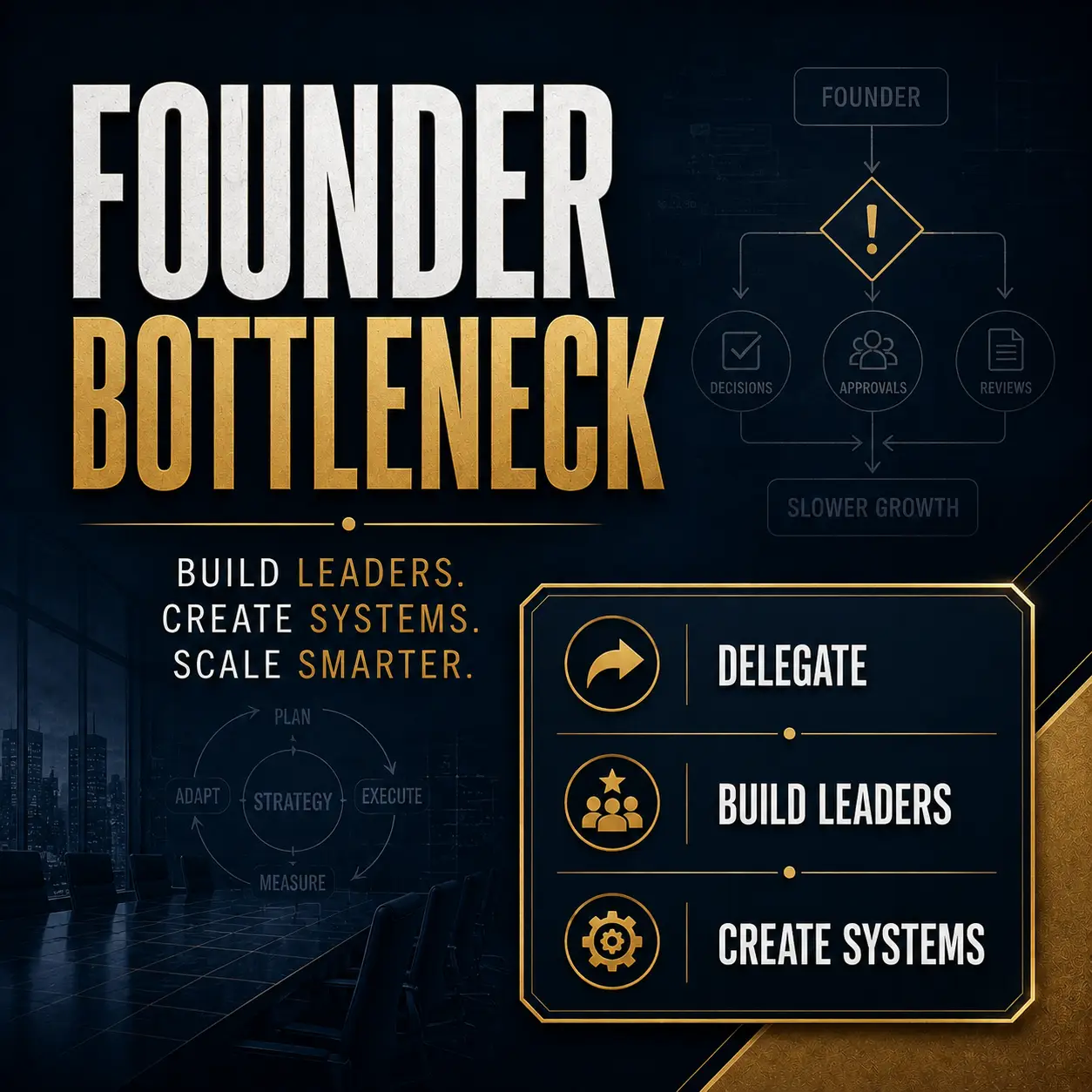
In the beginning, being involved in everything is often a strength.
You know every customer.
You approve every expense.
You make the important sales calls.
You solve the problems.
You interview the employees.
You know where the money is going.
That level of involvement can be exactly what a young company needs.
Then the company grows.
More customers.
More employees.
More locations.
More decisions.
More money at risk.
And the same founder who helped create the growth can suddenly become the person slowing it down.
That is the founder bottleneck.
I have spent more than 30 years building businesses, and one of the biggest transitions an entrepreneur has to make is realizing that the job changes as the company grows.
What made you valuable at the beginning may eventually become the thing you have to stop doing.
What Is a Founder Bottleneck?
A founder bottleneck exists when too much of the company’s ability to move depends on one person.
Usually the founder.
Decisions wait for you.
Problems wait for you.
Deals wait for you.
Employees wait for you.
Customers wait for you.
Managers wait for you.
Eventually the company begins moving at the speed of your available time.
That creates a hard ceiling.
There are only so many hours in your day.
If every meaningful decision requires the founder, the business can never become dramatically larger than the founder’s personal capacity.
The Problem Usually Starts With Good Intentions
Most founders do not intentionally create this problem.
They care.
They want things done correctly.
They know the business better than anyone.
They remember how hard it was to get the company started.
And usually they are pretty good at solving problems.
So people naturally keep bringing problems to them.
The founder starts thinking:
It will take me five minutes to handle this.
That may be true.
But if 40 people each bring you one five minute problem, you no longer have a five minute problem.
You have built a system where everyone is trained to escalate instead of decide.
That does not scale.
If Every Decision Comes to You, You Do Not Have Leaders Yet
One of the clearest signs of a founder bottleneck is constant approval.
Can I hire this person?
Can I give this customer a refund?
Can I negotiate this contract?
Can I spend this money?
Can I change the process?
Can I solve the problem this way?
There should absolutely be decisions that require the CEO.
But if competent executives cannot make meaningful decisions without asking permission, either you hired the wrong people or you have not actually given them authority.
A title does not create a leader.
Responsibility and decision making authority do.
If you hire a great operator and then require them to operate exactly the way you would, you are wasting the reason you hired them.
Your Job Changes as the Company Grows
The CEO of a startup and the CEO of a large company should not have identical calendars.
Early in the business, the founder may need to:
Sell.
Recruit.
Build the product.
Solve customer problems.
Negotiate leases.
Manage vendors.
Review expenses.
Create marketing.
Do whatever needs to be done.
That is entrepreneurship.
But as the business scales, the founder’s highest value should begin moving toward:
Vision.
Strategy.
Capital allocation.
Major negotiations.
Key relationships.
Executive talent.
Culture.
Large opportunities.
Critical decisions.
Seeing around corners.
Those are areas where the CEO can create disproportionate value.
The goal is not to work less.
The goal is to spend your time where it creates the most leverage.
Ask Yourself: What Can Only I Do?
This is one of the most useful questions a founder can ask.
What am I doing today that truly requires me?
Be honest.
There are probably things you enjoy doing.
Things you are good at.
Things you have always done.
That does not mean you should continue doing them.
If someone else can perform a task at 90% of your ability, and doing so frees you to work on something that could materially change the company, that may be a very good trade.
The CEO’s time should increasingly move toward decisions and opportunities where the CEO is uniquely valuable.
Everything else deserves scrutiny.
Hire People Who Are Better Than You
I have never believed the CEO should be the best person in the company at everything.
That would be a terrible organizational design.
Throughout my career, I have worked alongside people whose strengths are very different from mine.
I naturally gravitate toward vision, strategy, opportunities, and negotiation.
That becomes far more valuable when strong operators are translating ideas into execution and strong financial minds are creating structure around them.
The company becomes stronger because the skills are complementary.
You should want executives who make you less necessary in their area.
The great CFO should know finance better than you.
The great operator should know operations better than you.
The great sales leader should be able to run the sales organization without waiting for you.
That is not losing control.
That is building a company.
The Right Executive Is a Force Multiplier
A force multiplier creates an outsized increase in effectiveness.
Great executives do exactly that.
The right person does not simply take work off your desk.
They improve the work.
They build systems.
They develop people.
They catch problems earlier.
They create accountability.
They make decisions.
They expand what the company is capable of doing.
That is a very different hire from someone who simply completes tasks.
As your company grows, you should increasingly be looking for people who can own outcomes, not just activities.
Delegation Without Standards Is Abdication
There is another side to this.
Getting out of the way does not mean disappearing.
You cannot tell someone:
Handle operations.
Then return six months later and be surprised by the result.
Effective delegation requires clarity.
What does success look like?
What are the non negotiable standards?
Which numbers matter?
What authority does the person have?
Which decisions still require escalation?
How frequently are results reviewed?
Where are the boundaries?
People need room to operate.
They also need to understand what winning looks like.
Freedom without accountability creates chaos.
Accountability without freedom recreates the bottleneck.
You need both.
Stop Solving the Same Problem Twice
If the same problem keeps reaching the founder, the problem probably needs a system.
One customer issue is a customer issue.
Fifty similar customer issues are a process issue.
One employee misunderstanding something is a coaching opportunity.
A hundred employees misunderstanding it is a communication or training failure.
One location missing a standard may be a management problem.
Twenty locations missing it means something in the operating system is broken.
Founders are often excellent firefighters.
But the goal should eventually be to build a company that produces fewer fires.
Every recurring problem should trigger a question:
What system would prevent this from requiring me next time?
That is how organizations mature.
Build Information Systems So You Can Let Go
A lot of founders struggle to delegate because delegation feels like losing visibility.
I understand that.
When you built the business yourself, you were used to knowing everything.
Scaling changes that.
You cannot personally participate in thousands of customer transactions or conversations.
But you can build reporting that tells you whether performance is moving in the right direction.
You can measure:
Revenue.
Margins.
Labor.
Customer satisfaction.
Conversion.
Productivity.
Retention.
Performance by market.
Performance by location.
Performance by team.
Good data allows the founder to move from personally observing everything to managing the exceptions.
You do not need to touch every part of the company.
You need enough visibility to know where your attention is required.
Create Decision Rules
If employees repeatedly ask the founder the same type of question, create a framework.
Instead of answering:
Can I do this?
Give them the conditions under which the answer should be yes.
For example:
A manager can approve an expense below a defined amount.
A customer service leader can resolve an issue within certain guidelines.
A sales leader can negotiate within a defined margin.
An executive can hire within an approved headcount and compensation range.
Now you have transferred judgment instead of simply transferring tasks.
That is much more scalable.
The goal is to teach people how the company thinks.
Do Not Punish People for Making Decisions
You cannot tell your team to take ownership and then destroy them the first time they make a decision differently than you would have.
That trains people to stop deciding.
Obviously there are bad decisions that require accountability.
But there is a difference between negligence and a reasonable decision that produced an imperfect result.
If you want leaders, they need enough room to develop judgment.
Talk through the decision.
Why did you choose it?
What information did you have?
What would you do differently now?
What did we learn?
The company gets stronger when people become better decision makers.
If everyone is afraid to be wrong, everything will eventually come back to you.
Build Leaders Before You Need Them
One of the hardest times to develop leadership is during explosive growth.
By then you already need the person.
Start earlier.
Who on your team could run a larger department?
Who could manage managers?
Who understands the culture?
Who has good judgment?
Who takes ownership without being asked?
Who is capable of becoming significantly more valuable with the right coaching?
Identify those people before the organizational chart requires them.
A growing company should always be developing the next layer of leadership.
Otherwise every promotion creates another hole behind it.
Founder Dependency Hurts Business Value
There is also a financial reason to solve this problem.
A company that depends completely on the founder is usually a riskier company.
What happens if you leave?
What happens if you get sick?
What happens if you want to sell?
What happens if an investor wants to understand whether the business can continue without you?
The stronger the leadership team, systems, processes, reporting, and culture become, the more durable the company becomes.
You are not only making your life easier.
You are building enterprise value.
A buyer does not just want the founder’s talent.
They want a business that works.
Test the Business Without You
One of the easiest ways to expose founder dependency is to step away.
Not forever.
Just long enough to see what happens.
Take a week.
Take a real vacation.
Do not participate in every meeting.
Do not immediately respond to every message.
Watch what happens.
What stops?
Which decisions wait?
Who steps up?
What problems somehow resolve themselves?
Where does the organization struggle?
Those answers are valuable.
If the company cannot operate for a week without you, that is not a reason to avoid taking another week off.
It is a diagnostic telling you what needs to be built.
Your Goal Is Not to Become Irrelevant
There is a common misunderstanding here.
The founder should not be trying to become unnecessary.
The founder should be trying to become unnecessary in the wrong places.
You should still matter.
A lot.
But your value should come from the things that can create the biggest impact.
A major acquisition.
A critical partnership.
A new strategic direction.
Hiring an exceptional executive.
Allocating capital.
Opening a new market.
Protecting culture.
Building important relationships.
Finding the next force multiplier.
Those may create far more value than personally approving another expense report.
The Founder Should Become a Multiplier
The early founder often creates value through personal output.
The scalable CEO creates value through multiplication.
You hire someone who builds a department.
You create a system that improves 500 employees.
You make an introduction that creates a new revenue stream.
You hire an executive who improves an entire division.
You make one decision that affects 200 locations.
You create a culture that influences thousands of customer interactions you will never personally see.
That is leverage.
And that is the transition entrepreneurs have to make if they want the company to become much bigger than themselves.
Look at Your Calendar
If you want to know whether you are becoming the bottleneck, look at your calendar.
How much time is spent:
Approving?
Fixing?
Checking?
Answering questions someone else should answer?
Sitting in meetings where you are not required?
Solving problems that have happened before?
Now compare that with the time spent:
Thinking.
Building relationships.
Developing leaders.
Making major decisions.
Reviewing strategy.
Finding opportunities.
Planning what comes next.
That gap may tell you exactly what needs to change.
Build a Company, Not a Larger Job
Entrepreneurs work hard.
That is part of the deal.
But there is a difference between working hard because you are building something ambitious and working hard because the company cannot function without you.
One creates leverage.
The other creates dependency.
At some point, the entrepreneur has to make the transition from being the person who does everything to the person who builds the people and systems capable of doing everything.
That transition is uncomfortable.
You will watch people do things differently than you would.
You will have to trust.
You will have to let people make decisions.
You will have to accept that your role is changing.
But that is the job.
Because the ultimate goal should not be a business where the founder holds everything together.
It should be a business where great people, strong systems, clear standards, and a healthy culture allow the company to keep performing as it grows.
That is when the founder stops being the bottleneck.
And starts becoming the force multiplier.
Lived By: Jimmy Ralph
CEO Board of Advisors
Interesting in joining the BA Community? bainvite.com
Want to stay up to date with Jimmy Ralph?
Follow Jimmy on LinkedIn | X (formerly Twitter) | YouTube | Instagram | Facebook for leadership insights, business lessons, behind-the-scenes updates, and more!
Visit Board of Advisors website
Board of Advisors magazine | Board of Advisors X | Board of Advisors Youtube | Board of Advisors Instagram
Shameless Plug time: If you’re in the St. Pete/Tampa area and need video/drone film services, check out my nephew’s company HR Video and Drone!