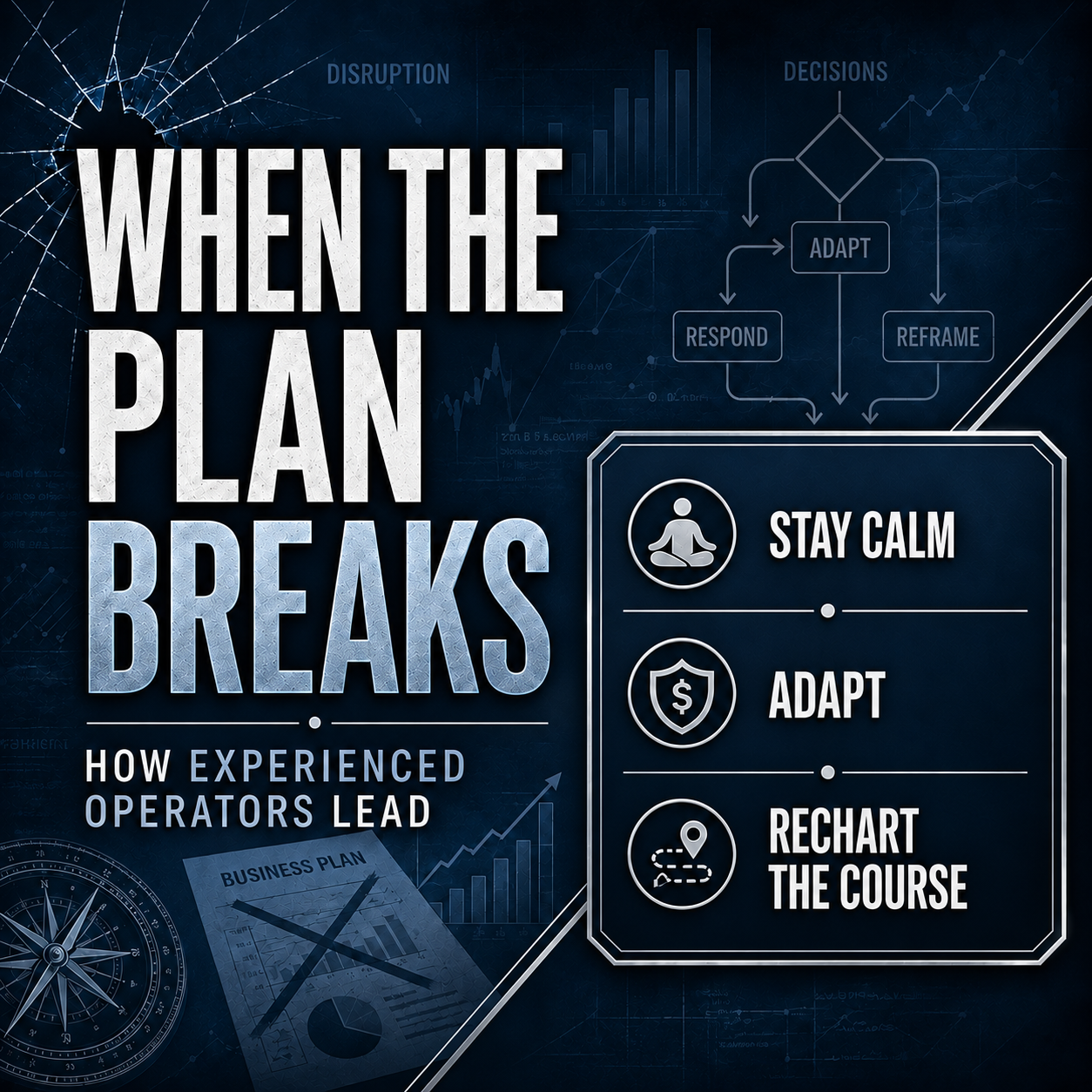
I have never seen a business plan unfold exactly the way it was written.
Not once.
You need the plan.
You need the forecast.
You need goals, budgets, timelines, and a clear destination.
But if you build a company long enough, something will eventually happen that was not in the spreadsheet.
A major customer leaves.
A key employee quits.
A deal falls apart.
Financing changes.
A competitor makes a move you did not expect.
The market shifts.
An acquisition develops problems.
Revenue misses.
Costs rise.
Something breaks.
That does not necessarily mean the plan was bad.
It means you are running a business.
After more than 30 years as an entrepreneur, I have learned that great operators are not the people who somehow avoid uncertainty.
They are the people who remain effective when uncertainty arrives.
Rule Number One: Don’t Panic
This sounds simple.
It is not.
When a serious problem appears, your brain naturally wants to jump ahead.
What happens if we lose the customer?
What happens to cash?
Are we going to miss payroll?
What will the employees think?
What happens to the deal?
What happens next quarter?
Those are legitimate questions.
But panic rarely improves the answers, stick to the plan, stick to the process.
The first responsibility of a leader is to separate the actual problem from the emotional reaction to the problem.
Ask:
What do we know?
What do we think we know?
What are we assuming?
Those are three different things.
Start with the facts.
The CEO’s Reaction Becomes Part of the Problem
When you lead a company, people watch you more closely than you realize.
If you and your CFO disappear into an office for an hour and walk out looking terrified, people notice.
They do not know what happened.
So they create their own explanation.
Something must be wrong.
Layoffs are coming.
We lost a customer.
The company is struggling.
Now the original business problem has created a second problem.
Fear.
Rumors.
Distraction.
Lower productivity.
A leader does not need to pretend everything is wonderful.
But leaders do need to understand that their behavior communicates constantly.
Your team is asking:
Do we have this under control?
Sometimes the most important thing you can give them is confidence that the answer is yes, you have a plan.
Get the Facts Before You Build the Story
One of the easiest mistakes during a crisis is reacting to incomplete information.
Sales are down.
Why?
Do not guess.
Find out.
A major customer is unhappy.
Why?
Talk to them.
Margins changed.
Where?
Look at the numbers.
A manager says the team is struggling.
What specifically is happening?
Get closer to the problem.
Experienced operators learn to resist the temptation to immediately create a story around incomplete facts.
Data first.
Interpretation second.
Decision third.
That sequence matters.
Bring in the Right People
You do not have to solve every serious problem alone.
In fact, that may be one of the worst times to try.
Bring in the people whose experience matters.
Your operator.
Your CFO.
Your attorney.
Your industry expert.
A trusted entrepreneur.
Someone who has already survived something similar.
This is where strong relationships become force multipliers.
A problem that feels completely unfamiliar to you may be very familiar to someone else.
They may recognize the pattern immediately.
That does not mean they make the decision for you.
It means you do not waste time rediscovering lessons that someone you trust has already learned.
Protect Cash
When business becomes uncertain, cash becomes oxygen.
Growth can hide inefficiency.
A downturn exposes it.
When the numbers start moving in the wrong direction, understand your cash position quickly.
How much runway do you have?
What expenses are fixed?
What can be reduced?
What can be delayed?
Where are you wasting money?
What receivables can be collected faster?
What commitments are approaching?
Which activities are actually producing revenue?
You do not have to slash everything.
In fact, indiscriminate cost cutting can damage the business you are trying to protect.
But leaders should know exactly where the money is going.
When conditions change, financial visibility becomes critical.
Protect the Things That Will Matter After the Storm
There is a difference between cutting costs and cutting muscle.
Be careful.
The easiest things to eliminate are not always the things you should eliminate.
Your best people.
Customer experience.
Training.
Sales capability.
Critical technology.
The culture you spent years building.
A business can become so focused on surviving the next three months that it destroys its ability to win during the next three years.
You have to protect the core.
Ask:
What will we absolutely need when conditions improve?
Protect that first.
Do Not Fall in Love With the Original Plan
Entrepreneurs need conviction.
We also need flexibility.
Those can exist at the same time.
You can remain completely committed to the destination while changing the route.
Maybe the original product changes.
Maybe the market changes.
Maybe the acquisition strategy changes.
Maybe the capital structure changes.
Maybe the timeline changes.
Maybe the people change.
That does not necessarily mean the vision failed.
It may mean the route needs to be recalculated.
One of the biggest mistakes entrepreneurs make is confusing persistence with rigidity.
Persistence means continuing toward the goal.
Rigidity means refusing to change how you get there.
Those are very different.
Know When the Problem Is Actually an Opportunity
Some of the most important changes in business begin with something going wrong.
A cost problem forces you to build a better operating system.
A labor problem leads you toward automation.
A difficult market exposes a better customer segment.
A lost customer forces you to diversify.
A failed acquisition teaches you exactly what to look for in the next one.
A competitor forces you to improve faster.
Adversity creates information.
The question is whether you are paying attention.
When something breaks, do not only ask:
How do we fix this?
Also ask:
What is this teaching us?
That second question can create enormous value.
Make the Decision
Eventually the analysis has to stop.
Leaders decide.
You will almost never have perfect information.
If you wait for complete certainty, the business will often move before you do.
Get the facts.
Get qualified perspectives.
Understand the downside.
Make the best decision available.
Then execute.
Indecision has a cost too.
Sometimes an imperfect decision made quickly is far less expensive than a perfect decision made three months too late.
Communicate Clearly
Once the decision is made, communicate.
What happened?
What are we doing?
Why?
Who owns what?
What changes?
What stays the same?
What does success look like now?
Uncertainty creates a vacuum.
If leadership does not fill it with clear information, people fill it themselves.
You do not need to tell every employee every detail.
But people should understand enough to know what is expected and where the company is going.
Clarity helps people get back to work.
Separate a Bad Month From a Broken Business
Not every setback requires a complete reinvention.
Sometimes sales have a bad month.
Sometimes a customer leaves.
Sometimes an employee makes a mistake.
Sometimes the market is temporarily strange.
Do not overreact.
The skill is determining whether you are dealing with:
A temporary problem.
A recurring problem.
A structural problem.
Those require very different responses.
Experienced operators develop judgment around that distinction.
You do not rebuild the company every time something goes wrong.
But you also do not ignore patterns simply because you hope they disappear.
Do a Real Postmortem
Once the immediate problem is under control, study it.
Do not waste the lesson.
What happened?
When did it actually begin?
What did we miss?
Which warning signs were visible?
What assumptions were wrong?
What worked during the response?
What failed?
What system should change?
Who needs to know what we learned?
The objective is not finding someone to blame.
The objective is making the organization stronger.
If the same preventable crisis keeps happening, you are not learning from it.
Build Systems From the Scar Tissue
Some of the best systems inside companies are created because something went wrong.
A financial control exists because money was once mishandled.
A hiring process exists because someone once made a terrible hire.
A contract standard exists because a previous agreement created a problem.
A reporting dashboard exists because leadership once found out too late.
A training process exists because execution became inconsistent.
Mistakes are expensive.
Make them pay tuition.
If you learn from them, the organization improves.
If you repeat them, you simply keep paying.
Resilience Is Not Pretending Everything Is Fine
Entrepreneurs talk a lot about resilience.
I do not think resilience means smiling while the company burns.
It means being willing to look directly at reality and continue functioning.
The numbers are what they are.
The deal fell apart.
The employee left.
The market changed.
Okay.
What do we do now?
That is resilience.
No drama.
No denial.
No wasting three weeks wishing the situation were different.
Accept reality faster.
Then act.
Experience Changes Your Relationship With Problems
One of the advantages of being in business for a long time is that you eventually realize most problems are survivable.
At the beginning of your career, every crisis feels enormous because you have nothing to compare it with.
After a few decades, you have seen a lot.
You have watched great quarters.
Terrible quarters.
Explosive growth.
Downturns.
Great hires.
Terrible hires.
Deals that changed the business.
Deals you were grateful did not happen.
Eventually you develop perspective.
You realize:
We will figure this out too.
That does not make you careless.
It makes you calmer.
Experience does not eliminate problems.
It improves your ability to put them in context.
Your Team Remembers How You Lead During the Hard Part
Anybody can lead when revenue is growing and everything is working.
People remember the difficult periods.
Did you disappear?
Did you panic?
Did you blame everyone?
Did you communicate?
Did you make the hard decision?
Did you protect the people who deserved protecting?
Did you tell the truth?
Did you keep moving?
Those moments build or destroy trust.
Culture is not really tested when everything is easy.
Culture is tested when there is pressure.
So is leadership.
Rechart the Course and Keep Moving
I believe in planning.
I believe in ambitious goals.
I believe entrepreneurs should think big and move quickly.
But I have never confused a business plan with a guarantee.
Things will change.
Something will eventually go wrong.
Sometimes several things will go wrong at the same time.
That is part of entrepreneurship.
The job is not to somehow create a company where nothing unexpected ever happens.
The job is to build yourself and your organization into something capable of responding when it does.
Don’t panic.
Get the facts.
Bring in the right people.
Protect cash.
Protect the core.
Make the decision.
Communicate.
Learn.
Rechart the course.
Keep moving.
You may be surprised how often the destination can remain exactly the same even when the route changes completely.
Lived By: Jimmy Ralph
CEO Board of Advisors
Interesting in joining the BA Community? bainvite.com
Want to stay up to date with Jimmy Ralph?
Follow Jimmy on LinkedIn | X (formerly Twitter) | YouTube | Instagram | Facebook for leadership insights, business lessons, behind-the-scenes updates, and more!
Visit Board of Advisors website
Board of Advisors magazine | Board of Advisors X | Board of Advisors Youtube | Board of Advisors Instagram
Shameless Plug time: If you’re in the St. Pete/Tampa area and need video/drone film services, check out my nephew’s company HR Video and Drone!