Some people spend years trying to figure out what they want to do with their lives. For me, entrepreneurship was never much of a question. It was simply what I grew up knowing.
My great-grandfather was an entrepreneur. My grandfather was an entrepreneur. My father was an entrepreneur. Building businesses, recognizing opportunities, and finding ways to make things happen were part of everyday life in my family.
I never really considered whether I was cut out for a traditional nine-to-five career because I didn’t grow up thinking that was the path I needed to follow.
But growing up around entrepreneurs and becoming a successful entrepreneur are two entirely different things.
Over more than 30 years of building businesses, I’ve experienced the excitement of spotting opportunities, the satisfaction of creating something valuable, and the reality of watching carefully developed plans fall apart.
I’ve learned about business growth, scalability, capital, mergers and acquisitions, and the extraordinary impact of having the right people around you.
And many of those lessons began long before I ever considered myself a businessman.
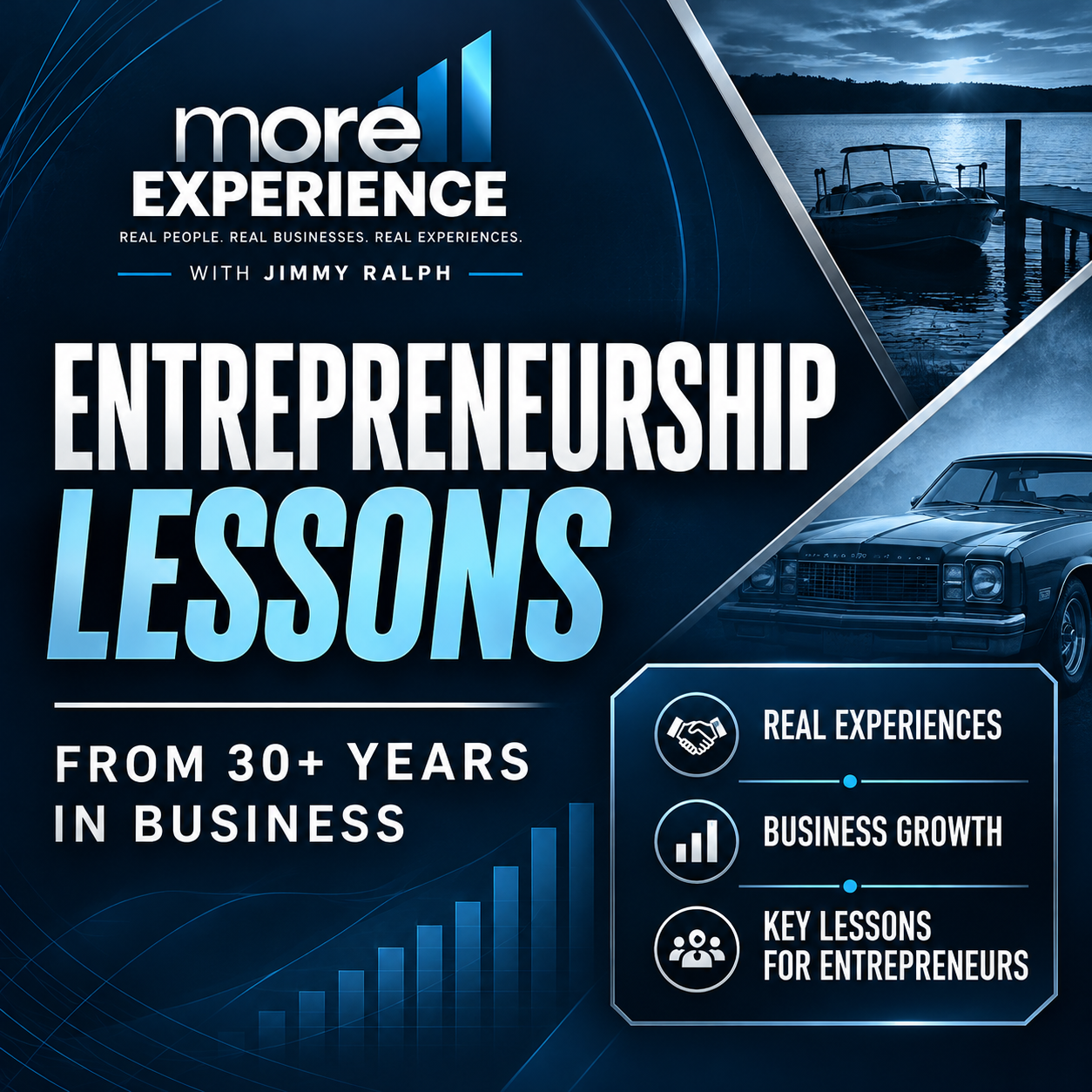
In the first episode of my new podcast, More Experience, I look back at those early ventures and share some of the most important entrepreneurship lessons I’ve learned along the way.
My First Lessons in Entrepreneurship Started on Lake Erie
I grew up along the southern shore of Lake Erie in Ohio, where the seasons created two very different opportunities for a young kid looking to make money.
During the summer, my friends and I would find old, beat-up boats, pool our money, fix them up, enjoy them for a while, and eventually try to sell them.
We also discovered another opportunity around the boat ramps.
When storms rolled across Lake Erie, boaters would rush to get their boats out of the water. Some were inexperienced, and plenty were understandably nervous about navigating rough conditions.
For a young teenager, earning $10 or $20 to help someone get their boat through a storm was a pretty good payday.
Looking back, we were learning an important business principle without realizing it: Find a problem people need solved, and figure out how to solve it.
But winter was where my first real business started to take shape.
A Snowplowing Business and a Brown Bag Full of Cash
Winters along Lake Erie were brutal. Heavy snowfall, freezing temperatures, and powerful winds made clearing driveways miserable, particularly for older residents.
My brother and I recognized an opportunity.
We borrowed an old tractor from our grandfather, got it running, attached a snow blade, and started going door to door after winter storms.
It became a legitimate little business.
We had repeat customers, predictable demand, and plenty of work. We even developed an understanding of what I would later recognize as customer retention.
I learned to push snow upwind because the wind would blow it back across the driveway, creating more work the following day.
It wasn’t a sophisticated marketing strategy, but I certainly understood repeat business.
By the time I was 16, I’d saved enough money to walk into a local car dealership and buy a Monte Carlo.
I remember carrying a brown paper bag full of cash into the showroom.
The salesman asked where my parents were.
I told him they were probably at home.
When he questioned how I expected to pay for the car, I put the bag of money on its roof.
He disappeared and returned with his sales manager.
I left with the car that day, although I believe my parents eventually had to sign some paperwork.
That experience taught me something that has stayed with me throughout my career.
There’s enormous satisfaction in recognizing an opportunity, putting in the work, and creating something valuable from your own efforts.
The money was important to a 16-year-old. But the experience of earning it was worth considerably more.
Finding Business Opportunities Where Others Don’t Look
After moving to Florida, I continued looking for business opportunities.
One of my earliest ventures came from something most people would never consider a business idea: dirty restaurant ceiling tiles.
A friend and I were having lunch at a seafood restaurant when we noticed the ceiling was covered with unattractive, aging tiles.
We started thinking about how we could improve the restaurant’s appearance and make money doing it.
Our idea was relatively straightforward.
We would replace the ceiling tiles with new ones featuring advertisements from local businesses.
The restaurant received an improved appearance, neighboring businesses received advertising exposure, and we collected revenue from selling those advertisements.
And it worked.
We found local businesses willing to pay for the exposure, and the restaurant benefited from the improvements.
But the experience introduced me to a problem that would influence how I evaluated business opportunities for decades.
A Profitable Business Isn’t Necessarily a Scalable Business
Once we sold the available advertising space, there wasn’t much more revenue to generate from that location.
We could look for additional restaurants, but the market was limited and expansion wasn’t straightforward.
We had created something that worked without developing a clear path to meaningful scale.
That distinction became increasingly important as my entrepreneurial career evolved.
Before starting a business, ask yourself whether the opportunity can grow beyond its original concept.
Can you expand into new markets? Introduce additional products? Increase distribution? Acquire competitors?
A business might generate income today without offering the long-term growth opportunities you’re looking for.
I learned that lesson selling advertisements on ceiling tiles. It became much more valuable when I began evaluating larger businesses years later.
The Business That Taught Me About Capital
My next venture came from recognizing another opportunity in Florida’s tourism industry.
Today, almost everyone carries a high-quality video camera in their pocket.
Back then, video cameras were expensive, bulky, and far less accessible.
A good camcorder could cost $1,500 to $2,000.
We recognized that vacationers might enjoy recording their trips without purchasing expensive equipment.
So we started a business called Memories to Go.
Tourists could rent camcorders, record their vacations, and return the equipment. We worked with a nearby business that could process the recordings and prepare a package to send to customers after their trip.
We distributed marketing materials through hotel lobbies and experimented with advertising to reach visitors.
Again, the business concept worked.
But there was a serious problem.
Demand Doesn’t Matter If You Can’t Meet It
During peak vacation periods like spring break, Memorial Day, or July Fourth, we could have rented significantly more cameras than we owned.
There were days when demand might have supported 100 rentals.
During slower periods, we might have had only two cameras rented.
Meeting peak demand would have required an enormous investment in inventory.
Purchasing 50 or 100 camcorders could have required $50,000 to $100,000, a significant amount of capital for entrepreneurs in their early twenties.
We couldn’t afford that inventory, and raising money to rent camcorders on the beach wasn’t particularly easy.
The experience taught me an important lesson about business capitalization.
A great idea and strong demand don’t guarantee a successful business if you lack the resources to execute.
You need enough capital to support inventory, operating expenses, customer acquisition, and the unexpected challenges that inevitably arise.
It was one of my first experiences with an undercapitalized business, and certainly not my last.
From Florida Beaches to International Telecommunications
One of my most interesting early ventures began through conversations and relationships.
I had met people familiar with telecommunications markets in Latin America. They explained how rapidly technology was evolving in North America while many Latin American countries were still operating with older telecommunications infrastructure.
At the same time, major telephone companies in the United States and Canada were upgrading their systems.
That meant they were removing large quantities of equipment that still had useful economic life.
I began to see an opportunity.
What if I could connect North American telecommunications companies looking to dispose of equipment with Latin American operators that needed it?
There was demand on one side and supply on the other.
The challenge was figuring out how to bring them together.
Learning International Business by Doing It
I found an advertisement from a Sarasota company looking for independent sales representatives to sell payphones in Latin America.
The advertisement said applicants needed to be bilingual.
I wasn’t.
As I joked on the podcast, I spoke pretty good Ohioan, so I figured I could make it work.
I took the opportunity and began traveling to countries including Costa Rica and the Dominican Republic.
Eventually, I expanded beyond payphones into larger telecommunications systems, including PBX equipment and central office switching systems.
I developed relationships with people in the industry, connected buyers and sellers, and learned how international transactions worked.
I had no formal background in import-export operations.
I was learning about customs, shipping requirements, international trade terminology, and contract structures as I went.
Over time, the business expanded across several Latin American markets, including Guatemala, Nicaragua, Panama, and Haiti.
I eventually established a sales and distribution office in Costa Rica.
It was an extraordinary learning experience.
I was traveling internationally, developing relationships, negotiating transactions, and building a business in markets I had known very little about just a few years earlier.
I even found myself in Panama during the extraordinary events surrounding Manuel Noriega’s removal from power.
Those experiences taught me far more than I could have learned by studying international business from a distance.
But by 1991, my first son had arrived, and the amount of travel had become difficult to reconcile with my growing family.
I began moving away from that business.
Looking back, I recognized another important gap in my entrepreneurial education.
I had built a business without developing a clear exit strategy.
That was something I would approach very differently in future ventures.
Why I Learned to Prioritize Scalable Businesses
As I gained more experience, I became increasingly focused on businesses with substantial opportunities for growth.
I started thinking beyond the next sale, the next quarter, or the next payroll.
I wanted to understand where a company could go over the next several years.
Could it expand geographically? Could it enter new categories? Could it increase profitability through better systems and operational discipline?
And could it grow through mergers and acquisitions?
On the podcast, I explain:
“I love M&A. I love to buy EBITDA. I love to build EBITDA.”
EBITDA, or earnings before interest, taxes, depreciation, and amortization, is one measure commonly used to evaluate a company’s operating performance.
Acquiring an established business can provide an existing customer base, revenue, operations, and a foundation for future growth.
With the right acquisition strategy, leadership, and execution, that foundation can become considerably more valuable.
I particularly enjoy applying experience, relationships, management systems, and talented people to businesses that have untapped potential.
As I said during the conversation:
“You can buy your way there, you can market your way there, you can direct sell your way there.”
The important part is having a business model capable of supporting that growth.
Of course, acquisitions aren’t automatically successful. Purchase price, financial performance, integration, and execution all matter.
But I learned to evaluate companies based on what they could become, not simply what they were doing today.
The 3 Traits Every Successful Entrepreneur Needs
After more than three decades in entrepreneurship, I’ve developed a simple framework for the qualities I believe matter most.
I call them the Three Rs of Entrepreneurship: Resolve, Resilience, and Relationships.
1. Resolve: Commit to the Vision
Entrepreneurs face constant uncertainty.
There will always be a reason to question your strategy, your timing, or your decision to pursue a particular opportunity.
Resolve means developing conviction around a well-considered direction and committing yourself to the work required to pursue it.
As I explain in the episode, when you’ve determined what you’re going to do and how you’re going to approach the market, you need to be resolute.
That doesn’t mean ignoring facts or refusing to make necessary adjustments.
It means having enough conviction that ordinary obstacles don’t cause you to abandon your objectives.
2. Resilience: Respond When Things Go Wrong
Resolve gets you moving.
Resilience keeps you moving when circumstances change.
Every entrepreneur eventually experiences the kind of setback that takes their breath away.
It might be a lost customer, an unexpected competitor, a market disruption, or an operational problem nobody anticipated.
During the podcast, I describe the reality pretty directly:
“You’re gonna get kicked in the teeth once in a while.”
You can spend a few minutes being frustrated, disappointed, or wondering how something happened.
But eventually, you have to start solving the problem.
Successful entrepreneurship requires the ability to recover, adapt, and continue executing when your original plan encounters resistance.
The challenges won’t stop coming simply because you’ve become more experienced.
You get better at responding to them.
3. Relationships: Your Greatest Business Safety Net
Of the Three Rs, relationships are the one I return to most frequently.
I’ve seen firsthand how the right people can create extraordinary opportunities and help entrepreneurs navigate situations they couldn’t overcome alone.
One of my favorite expressions is:
“The one thing that makes you or saves you, and oftentimes both … is having the right relationships.”
But meaningful relationships aren’t something you can manufacture overnight when you suddenly need help.
You have to invest in them long before that moment arrives.
Help people solve problems. Make introductions. Share knowledge. Be someone others can rely on.
When you consistently invest in relationships without expecting something immediate in return, you build a network of people who know your character and trust your judgment.
And when the unexpected happens, those relationships can become your greatest advantage.
The Entrepreneurship Lesson I Wish I’d Learned Earlier
If I could go back and give my younger self one piece of advice, it would be to plan further ahead and be much more conservative about capital requirements.
Young entrepreneurs frequently underestimate what their businesses will cost and overestimate how quickly they’ll achieve their targets.
I’ve been guilty of it myself.
I often tell entrepreneurs:
“It always takes twice as long and costs twice as much.”
That’s an intentionally conservative rule of thumb, not a literal prediction for every business.
But there’s a valuable principle behind it.
If you budget for additional time, maintain adequate cash reserves, account for slower revenue growth, and anticipate unexpected expenses, you’ll be better prepared when reality doesn’t match your original projections.
If things go better than expected, that’s a great problem to have.
If things take longer, you have a better chance of staying in business long enough to succeed.
A good business can still fail because it runs out of capital before reaching its potential.
Don’t allow optimistic assumptions to become your entire financial strategy.
There’s Always More Experience to Learn From
When I look back at my early entrepreneurial journey, I see a series of experiences that gradually shaped how I approach business today.
Snowplowing taught me to recognize demand and work hard.
Selling ceiling tile advertisements taught me about the limits of scalability.
Renting camcorders taught me the importance of capitalization.
International telecommunications taught me about relationships, market opportunities, and the value of learning through experience.
And decades of building businesses since then have reinforced the importance of resolve, resilience, and surrounding yourself with the right people.
I still love entrepreneurship as much as I ever have.
I love the challenge of building something, finding opportunities, solving difficult problems, and working alongside exceptional people.
That’s one of the reasons I created More Experience.
I want to share the lessons I’ve learned, including the mistakes, and have meaningful conversations with other entrepreneurs, CEOs, investors, and business leaders who have their own experiences worth sharing.
No matter how successful you become or how long you’ve been in business, there’s always someone who has learned something you haven’t.
And sometimes, hearing that lesson at the right moment can save you years of frustration.
Real People. Real Businesses. Real Experiences.
Watch the first episode of More Experience with Jimmy Ralph on YouTube, or listen on Spotify and Apple Podcasts, to hear the full stories behind these early entrepreneurial experiences.
By Jimmy Ralph | Entrepreneur, CEO of More³, and Host of More Experience
Want to stay up to date with Jimmy Ralph?
Follow Jimmy on LinkedIn | X (formerly Twitter) | YouTube | Instagram | Facebook for leadership insights, business lessons, behind-the-scenes updates, and more!
Follow the More Experience Podcast on: Apple Podcasts | Spotify | Youtube | X | Instagram | Facebook | LinkedIn
Follow More³ on: X | Instagram | Facebook | LinkedIn