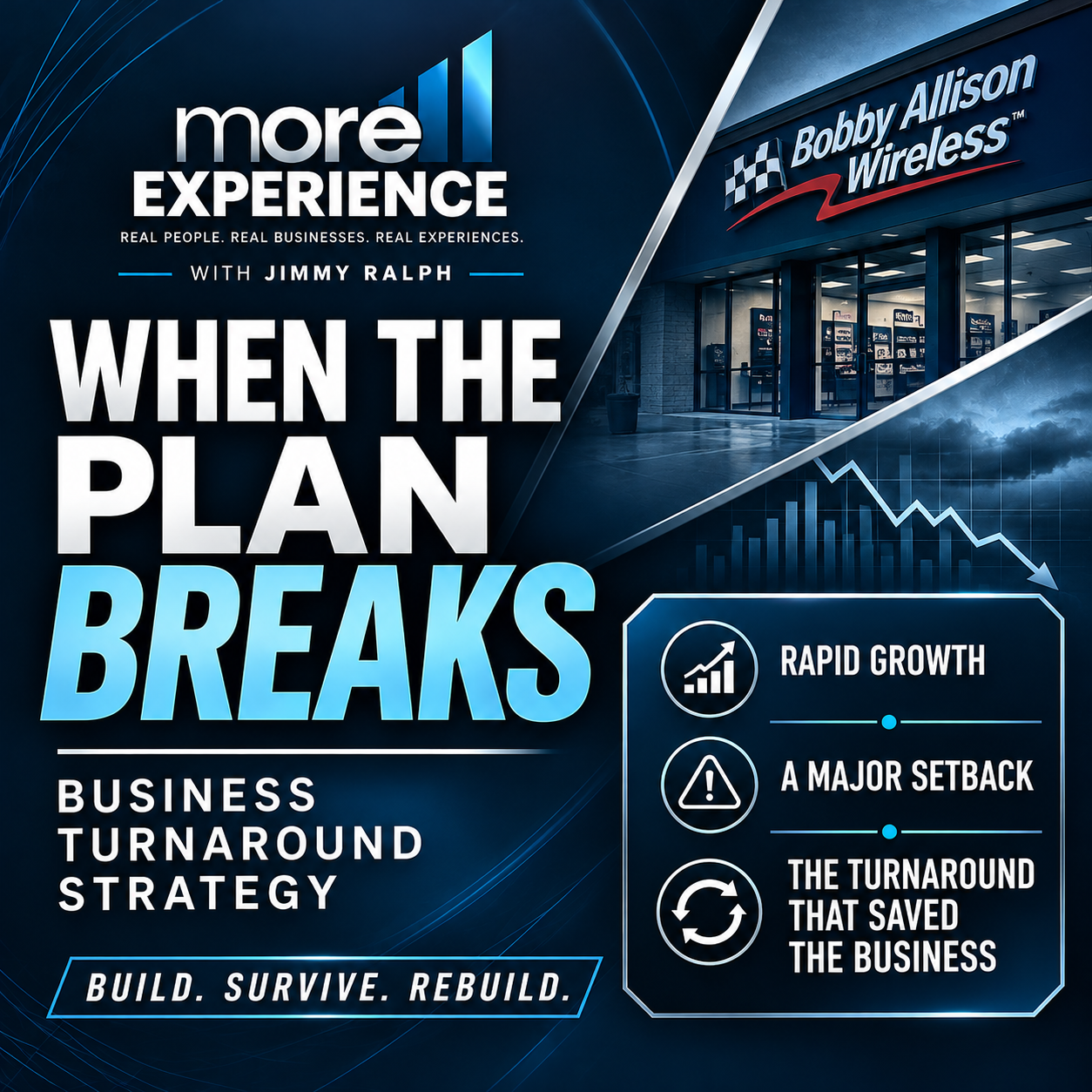
Business Turnaround Strategy: How I Built, Nearly Lost, and Rebuilt Bobby Allison Wireless
Some of the most valuable lessons I’ve learned in more than 30 years of entrepreneurship came from experiences I wouldn’t wish on anyone.
I’ve built businesses, raised capital, negotiated acquisitions, and worked with some extraordinary people. I’ve also found myself in situations where everything we had worked to build was suddenly at risk.
One of the defining chapters of my career was Bobby Allison Wireless.
What began as an unexpected introduction on a lake in Alabama became an opportunity to build a substantial wireless retail company. We recognized an emerging market, developed relationships with investors, raised capital, and began expanding across the country.
Then September 11, 2001, changed everything.
A financing arrangement we had been counting on fell apart, leaving us with millions of dollars in commitments and no practical way to fund them. Within months, we were in Chapter 11 bankruptcy proceedings, fighting to keep the business alive.
That experience fundamentally changed how I approach entrepreneurship, capital, leadership, risk, and business turnaround strategy.
In the second episode of More Experience, I share the story of Bobby Allison Wireless, including the decisions that drove our growth, the circumstances that threatened the company, and the lessons that continue to influence how I build businesses today.
How a Chance Relationship Led to Bobby Allison Wireless
I’ve spent much of my career talking about the importance of building meaningful relationships.
The Bobby Allison Wireless story is a perfect example of why.
Years earlier, while working in international telecommunications, I developed a friendship with someone in the Huntsville and Guntersville, Alabama, area.
One holiday weekend, I was visiting him and spending time on his boat on Lake Guntersville.
During that visit, we met a gentleman who had worked as the business manager for legendary NASCAR driver Bobby Allison.
He mentioned that Bobby had invested in approximately a dozen wireless phone stores around Huntsville.
Unfortunately, the stores weren’t performing particularly well.
They were losing money, and the people involved weren’t sure whether they should try to turn the operation around or find a way out.
Because of my telecommunications background, I was asked whether I might be able to help.
There was one fairly significant detail.
I’d never operated a retail business before.
But I understood the fundamentals of business. You need revenue, controlled expenses, sufficient capital, effective marketing, and customers who have a reason to keep doing business with you.
I believed those fundamentals could be applied to retail.
So I took a look at the opportunity.
Turning a Struggling Operation Into Something Bigger
The initial objective was to improve the existing stores and stop the losses.
But as I became familiar with the business, I recognized something much more interesting.
Wireless phones were becoming increasingly important to consumers, yet the industry hadn’t fully embraced the kind of retail experience people were accustomed to in other categories.
I saw an opportunity to build something significantly larger.
I approached Bobby about expanding the business, using his name and recognition to establish a stronger retail brand.
Bobby was an extraordinary person to work with. Despite his success and celebrity, he was humble, approachable, and genuinely enjoyable to be around.
He was enthusiastic about the idea.
That conversation helped launch the next chapter of Bobby Allison Wireless.
The entire opportunity had originated through a friendship, a chance introduction, and a willingness to help solve somebody else’s problem.
It’s a lesson I’ve returned to throughout my career.
The right relationship can create an opportunity you couldn’t have planned or predicted.
Recognizing the Wireless Retail Opportunity Before It Became Mainstream
Today, it’s difficult to imagine an economy where wireless phones aren’t a routine retail purchase.
In the 1990s, that wasn’t the case.
Wireless carriers operated company stores, but many of those locations functioned more like customer service centers than modern retail destinations.
Independent wireless retailers were still developing, and the shopping experience was very different from what consumers expect today.
I believed that was about to change.
Consumers were becoming more comfortable purchasing wireless phones, and the technology was evolving rapidly.
I saw an opportunity to establish a recognizable retail brand before the market matured.
At the time, we were watching trends develop in different parts of the country and trying to anticipate where consumer behavior was headed.
The objective was to get ahead of the opportunity rather than wait until the industry was already crowded with competitors.
Why Timing Matters in Entrepreneurship
Recognizing a growing market is important, but identifying the right time to enter it can be just as valuable.
If you’re too early, you may spend enormous amounts of money educating customers and developing demand that doesn’t yet exist.
If you’re too late, established competitors may already control the best locations, relationships, and customer base.
With Bobby Allison Wireless, we believed we had an opportunity to participate in a major shift in how consumers purchased wireless services.
The concept was working.
We began building a business that could serve customers through professionally designed retail locations in major shopping centers and other high-traffic areas.
But expansion required significant capital.
And that would eventually become our greatest vulnerability.
The Capital Requirements of Scaling a Retail Business
Opening wireless stores in the late 1990s was not a simple or inexpensive undertaking.
These weren’t small displays that could be installed overnight.
We were developing full retail locations inside major shopping malls, often working with large property owners and developers such as Simon and Westfield.
Those companies maintained demanding standards for store design, construction, merchandising, and appearance.
A single location might require $100,000 to $150,000 in build-out costs.
Then there were inventory requirements, lease commitments, staffing expenses, marketing, and the working capital necessary to support operations while a new location developed its customer base.
Some stores required more than a year before reaching profitability.
Now multiply those commitments across dozens of locations.
You quickly begin to understand the financial demands involved in scaling a retail business.
Raising Capital to Support Expansion
We initially proved the business model through a combination of early investments and smaller store openings.
As the concept developed, we established relationships with Stern Agee & Leach, an investment banking firm with roots in Alabama.
Those relationships helped us pursue larger financing opportunities and supported the company’s expansion.
We also completed a reverse merger involving an existing public company, creating another chapter in the development of Bobby Allison Wireless.
By the time we had grown to approximately 35 or 40 stores, we were preparing for a much larger national expansion.
The opportunity was exciting.
We had the market, the concept, and the ambition to take the business to another level.
We also believed we had the financing lined up.
And that’s where one of the most difficult experiences of my career began.
When September 11 Changed Everything
In 2001, we were working with an investment banking firm on a substantial financing arrangement intended to support another round of store openings.
The plan involved expanding by approximately 60 additional locations.
That required a credit facility potentially in the range of $20 million to $25 million.
Before the capital could be released, however, there were conditions we needed to satisfy.
One of the primary concerns from the financing side was whether we could secure the necessary retail leases.
That wasn’t something I was particularly worried about.
We had developed strong relationships with major mall operators, and I was confident in our ability to negotiate the locations we needed.
So we went to work.
We secured lease commitments and began preparing for the next wave of expansion.
Then came September 11, 2001.
The attacks were a national tragedy with devastating human consequences. They also created extraordinary economic uncertainty, disrupting industries, financial institutions, and businesses across the country.
Bobby Allison Wireless was one of the businesses caught in the aftermath.
A few weeks later, we received notice that the expected financing would not proceed.
The capital we were depending on was no longer available.
But our obligations hadn’t disappeared.
Millions in Commitments Without the Capital to Fund Them
We had already made substantial commitments to landlords and contractors.
Some locations were under construction. Others had signed agreements and upcoming obligations.
We had expansion plans that depended on financing we suddenly couldn’t access.
The underlying retail business was operating, but the commitments associated with our planned expansion had created a financial problem we couldn’t simply ignore.
I remember how frightening that realization was.
I’d encountered business challenges before, but nothing approaching this scale.
We were dealing with landlords, creditors, legal obligations, and financing problems that threatened the entire company.
The situation developed rapidly.
And it became clear that Chapter 11 bankruptcy protection was likely our only viable path forward.
One of the hardest lessons in entrepreneurship is discovering that a business can have a promising future and still face a financial crisis that threatens its survival.
The Business Turnaround Strategy That Helped Us Survive
Chapter 11 bankruptcy is a legal process that can allow a business to reorganize its financial obligations while continuing operations under court supervision.
It is different from immediately liquidating the business and selling its assets.
For Bobby Allison Wireless, that distinction was critical.
I believed we had a fundamentally viable business.
The existing stores were generating revenue, and I believed their operations could support a profitable company.
Our immediate challenge was the financial burden created by the interrupted expansion.
We needed a way to reorganize those obligations without destroying the business underneath them.
In the podcast, I describe entering bankruptcy proceedings in December 2001, roughly three months after September 11.
I had never experienced anything like it.
We had to confront the possibility that the company could be dismantled, even though I believed we could preserve more value by keeping it operating.
Fighting to Keep the Business Alive
For more than a year, I spent an extraordinary amount of time in bankruptcy court in South Florida.
Creditors and their attorneys were understandably focused on protecting their financial interests.
Some wanted the business liquidated.
I believed that would produce a worse outcome than allowing us to reorganize and continue operating.
As I explained during the interview:
“I’m gonna get it out the other end of the Chapter 11.”
That became our objective.
We had to explain our plans, defend our operating decisions, and demonstrate why keeping the business alive could create a better recovery for creditors.
We also had to make difficult operating decisions, evaluate expenses, and work through the obligations associated with our expansion.
None of it was easy.
But we remained committed to demonstrating that the company was worth saving.
Knowing Every Dollar in Your Business
One of the most valuable lessons came from the financial discipline required during the proceedings.
When you’re being questioned in court about your company’s finances, you need to understand exactly what’s happening inside the business.
You need to know where the money is going, what expenses are necessary, and what results your decisions are producing.
There isn’t much room for vague explanations.
You have to understand the numbers.
In the podcast, I described the experience this way:
“You know where every penny is in that business.”
That level of financial accountability stayed with me long after the proceedings ended.
It reinforced the importance of detailed reporting, disciplined cash management, and maintaining a clear understanding of a company’s operating performance.
Those principles became foundational to how I approached future businesses.
Why Leadership and Communication Matter During a Business Crisis
One of the hardest parts of leading a company through financial distress is managing the uncertainty experienced by everyone connected to the business.
Employees want to know whether their jobs are safe and whether their paychecks will arrive.
Investors want to understand the risks to their capital and whether there is a credible recovery plan.
Vendors and lenders need confidence that the business is approaching its obligations responsibly.
The challenge is that each group views the situation from a different perspective.
You can’t eliminate everyone’s concerns, but you can communicate clearly.
Throughout the Bobby Allison Wireless restructuring, I learned to explain the situation honestly and address the concerns most important to each audience.
That meant acknowledging the challenges while explaining why we believed the company had a viable path forward.
In a crisis, credibility comes from honest communication supported by a plan people can understand.
Leadership doesn’t mean pretending everything is fine.
It means recognizing the situation, taking responsibility, and helping people understand what needs to happen next.
The Force Multipliers Who Helped Shape My Future
I’ve always believed that entrepreneurs achieve more when they surround themselves with people whose abilities complement their own.
The Bobby Allison Wireless experience reinforced that belief.
During that difficult period and its aftermath, I developed relationships with people who would become instrumental in future business ventures.
Two of those individuals were Chris DiPasquale and Kevin Killoran.
Chris would become a trusted CFO, bringing financial expertise, strategic thinking, and a strong understanding of capital structures, acquisitions, and business operations.
Kevin would become a trusted COO, with an exceptional ability to simplify complicated operating challenges and turn them into plans that teams could execute.
Their expertise complemented my own strengths.
Together, we would go on to navigate significant opportunities and challenges in future businesses.
I often refer to people like Chris and Kevin as force multipliers.
A force multiplier is someone whose knowledge, experience, relationships, or capabilities create an outsized impact on what an individual or organization can accomplish.
The right person can fundamentally improve your ability to execute.
And sometimes those relationships emerge during the most difficult periods of your career.
What Happened to Bobby Allison Wireless?
Through the restructuring process, we were able to improve the profitability of the underlying business and work toward a successful emergence from Chapter 11.
It required difficult decisions, determination, and the support of people who believed in what we were trying to accomplish.
But we did emerge.
We were able to preserve value in the business, sell portions of the operation, and provide creditors with greater recoveries than I believed liquidation would have produced.
The experience was painful, but it also became one of the most important educational periods of my entrepreneurial career.
I learned about financial structures, legal obligations, creditor negotiations, turnaround management, and the importance of surrounding myself with people who understood disciplines I had never previously encountered.
I carried those lessons into every business that followed.
In fact, the relationships and industry knowledge developed during that chapter helped create the foundation for what would eventually become Talk More Wireless.
5 Business Turnaround Lessons Every Entrepreneur Should Understand
When I look back at Bobby Allison Wireless, five lessons stand out.
1. Plan for uncertainty before it arrives.
No business plan can anticipate every major disruption. Maintain financial flexibility and understand how your company would respond if expected revenue or financing suddenly disappeared.
2. Never confuse access to capital with guaranteed capital.
Financing arrangements can contain conditions, dependencies, and risks. Understand those requirements before making substantial commitments.
3. Know your numbers.
Cash flow, operating expenses, profitability, and financial obligations need to be understood in detail. During a crisis, that knowledge becomes essential.
4. Communicate honestly and consistently.
Employees, investors, lenders, and partners need information they can trust. Explain the challenges, share the plan, and follow through.
5. Build relationships before you need them.
The right advisors, financial experts, operators, and business relationships can create options you may not be able to develop on your own.
These lessons apply whether you’re operating a handful of retail locations or managing a much larger organization.
The scale may change, but the fundamentals remain remarkably consistent.
The Most Valuable Business Lessons Aren’t Always the Ones You Want
I wouldn’t recommend Chapter 11 bankruptcy as a preferred way to learn how to run a business.
But I can tell you that the experience taught me lessons I might never have learned otherwise.
It gave me a deeper understanding of financial discipline, the importance of resiliency, and the consequences of making commitments based on assumptions that don’t materialize.
It also reinforced the philosophy that continues to guide my career.
You have to be resolute in pursuing your objectives.
You have to be resilient when circumstances challenge your plans.
And you have to build meaningful relationships with people who can help you navigate opportunities and adversity.
Those are the Three Rs of Entrepreneurship.
The Bobby Allison Wireless experience tested all three.
Today, through More Experience, I want to share stories like this because the most valuable business education often comes from understanding what happened when things didn’t go according to plan.
If these experiences help another entrepreneur recognize a risk earlier, make a better financial decision, or appreciate the value of the right relationship, then sharing the story is worthwhile.
Real People. Real Businesses. Real Experiences.
Watch the Bobby Allison Wireless episode of More Experience with Jimmy Ralph on YouTube, or listen on Spotify and Apple Podcasts, to hear the full story behind the growth, restructuring, and lessons learned.
By Jimmy Ralph | Entrepreneur, CEO of More³, and Host of More Experience
Want to stay up to date with Jimmy Ralph?
Follow Jimmy on LinkedIn | X (formerly Twitter) | YouTube | Instagram | Facebook for leadership insights, business lessons, behind-the-scenes updates, and more!
Follow the More Experience Podcast on: Apple Podcasts | Spotify | Youtube | X | Instagram | Facebook | LinkedIn
Follow More³ on: X | Instagram | Facebook | LinkedIn