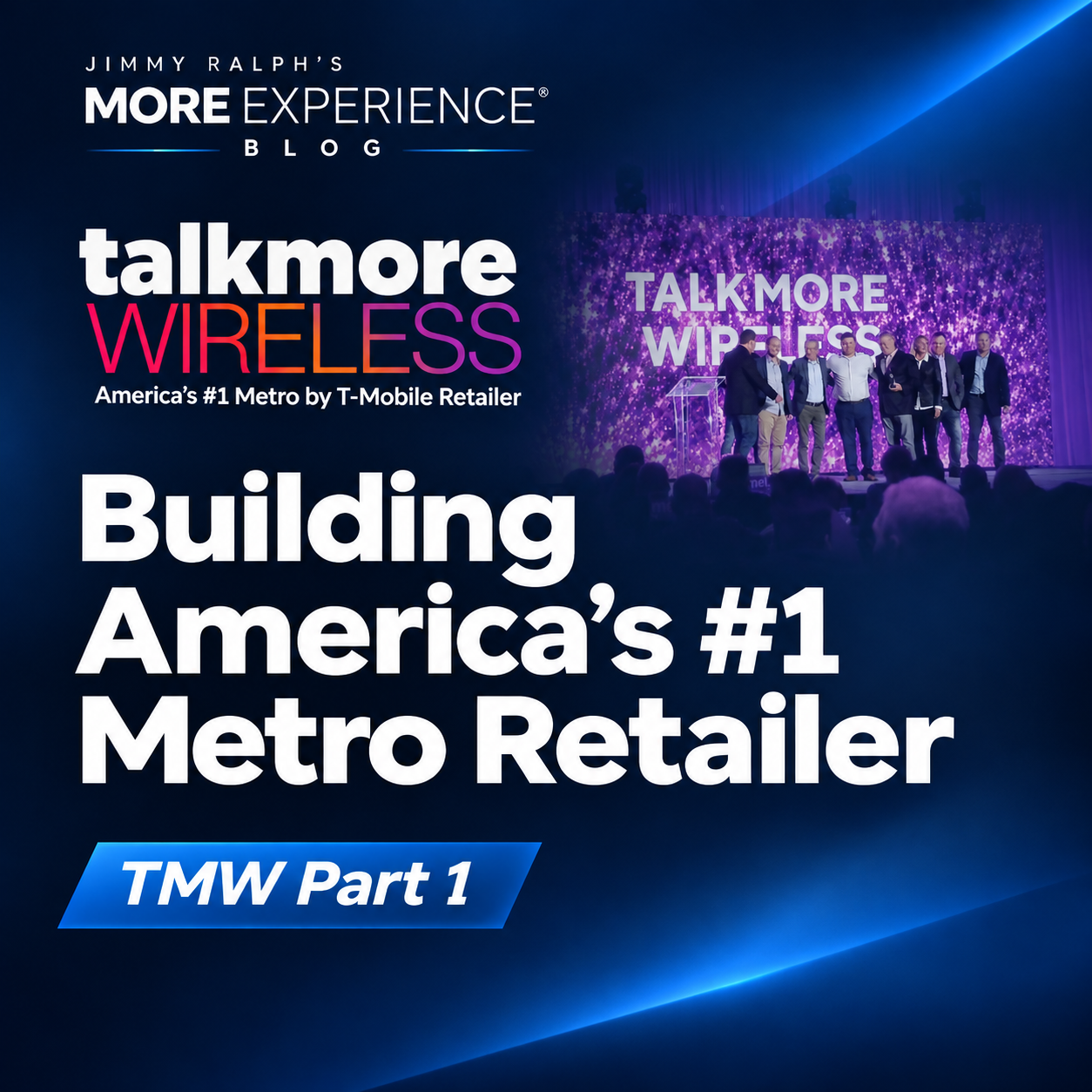
Building a business from the ground up is an incredible experience. Taking an established business, recognizing its untapped potential, and turning it into something exponentially larger is an entirely different challenge.
I’ve had the opportunity to do both throughout my entrepreneurial career.
One of the most rewarding chapters was building Talk More Wireless (TMW), a MetroPCS retailer that would eventually grow into one of the largest Metro by T-Mobile retail organizations in the United States.
But that journey didn’t begin with hundreds of locations, a large management team, or a sophisticated acquisition strategy.
It began with approximately 13 or 14 stores and a telephone call from people I’d developed relationships with years earlier.
What followed was an opportunity to apply decades of experience in retail operations, sales management, acquisitions, employee development, and customer service to a business I believed had extraordinary growth potential.
In this episode of More Experience, I discuss how Talk More Wireless began, why we made the decision to pursue aggressive expansion, and the principles that allowed us to grow without sacrificing the culture that made the business successful.
It’s a story about business acquisitions and growth, but more importantly, it’s about what happens when you combine the right opportunities with the right people, systems, and relationships.
How Talk More Wireless Got Its Start in 2002
The origins of Talk More Wireless go back to the conclusion of another important chapter in my entrepreneurial career: Bobby Allison Wireless.
During the restructuring and eventual transition of that business, we had developed relationships with MetroPCS, a wireless carrier that was building a different kind of business.
MetroPCS focused on prepaid wireless services without the traditional long-term contracts and credit requirements common in the industry at the time.
I believed that model had tremendous potential.
It was accessible, straightforward, and particularly well suited for customers who wanted reliable wireless service without the complications of traditional contract-based plans.
I saw it as an important part of the industry’s future.
As we worked through the final stages of Bobby Allison Wireless, some of the remaining stores were sold to another company.
That organization ultimately decided it didn’t want to continue operating under its MetroPCS arrangement.
I thought that was a mistake.
We had developed a good relationship with MetroPCS, and I believed the business model was only going to become more relevant.
Then something interesting happened.
The Relationship That Opened the Door
Not long after the other company terminated its relationship with MetroPCS, I received a call from people I knew at the carrier.
They were familiar with our operating capabilities and the results we’d produced.
They asked whether I would be interested in becoming a MetroPCS dealer under my own company and taking over a number of the stores that had previously been operating successfully.
As I recalled during the podcast, my response was pretty simple:
“Well, let me think about it. Yes.”
It was an opportunity that made sense almost immediately.
We understood the industry, believed in the brand, and had the experience to operate the stores effectively.
In 2002, we relaunched approximately 13 or 14 locations.
That was the beginning of Talk More Wireless.
Looking back, it was another example of something I’ve said throughout my career:
The right relationship can create an opportunity you never could have anticipated.
And sometimes, that opportunity becomes the foundation for something extraordinary.
Recognizing the Opportunity in Prepaid Wireless
One reason I was particularly enthusiastic about MetroPCS was that I believed the wireless industry was evolving.
Traditional wireless services often involved long-term contracts, credit checks, and pricing structures that didn’t appeal to every customer.
MetroPCS offered a different approach.
It made wireless service more accessible to consumers who wanted a simpler way to stay connected.
The retail model was also attractive.
Unlike businesses where customers purchased a product and might not return for years, prepaid wireless created regular opportunities for customer interaction.
Many customers visited their local stores to pay bills, upgrade phones, purchase accessories, or get assistance with service-related questions.
That made the retail experience especially important.
These weren’t simply places where people purchased phones.
They were neighborhood businesses where customers expected to develop relationships with the people serving them.
I recognized that those interactions could become a significant competitive advantage if we approached them correctly.
Why We Decided to Pursue Aggressive Growth
For approximately 15 years, those original stores remained part of our business activities while we pursued other opportunities.
During that period, we developed substantial retail operating capabilities through Retail Business Development (RBD) and SalesMakers.
Those companies had allowed us to build and manage retail programs for major corporations, including Microsoft, Sprint, Vonage, and others.
We had developed experience recruiting thousands of employees, operating across multiple states, managing complex retail programs, and using technology to oversee distributed teams.
We had also created a management system called Everpresent Management, or EPM, which allowed us to communicate with and manage retail operations remotely.
By 2015 and 2016, we began asking ourselves an important question.
What if we took all those capabilities we’d developed for other companies and applied them to our own MetroPCS business?
We already understood the market.
We already had the relationships.
We had experienced leadership, established processes, and technology that could support a much larger operation.
Instead of continually moving from one major client project to another, we had an opportunity to build long-term value in a business we controlled.
Turning Experience Into a Competitive Advantage
We made the strategic decision to expand Talk More Wireless.
Initially, that meant opening additional stores organically and pursuing smaller acquisitions.
By late 2016, we were beginning to accelerate those efforts.
In 2017, we brought in additional capital through a partial equity partner, giving us more resources to pursue acquisitions and new store development.
We began identifying smaller MetroPCS businesses with approximately eight or ten locations that we believed could benefit from our operational expertise.
By the time we entered 2018, we had expanded into approximately 60 locations.
It was a substantial change from the original group of stores.
But the real objective wasn’t simply to increase our store count.
We wanted to build a retail organization that could deliver a consistently excellent experience at scale.
Growth was important. But operational excellence was what would make that growth sustainable.
Why I Prefer Acquisitions Over Opening New Locations
I’ve always enjoyed mergers and acquisitions.
I like buying established businesses with real operating histories and then applying the right resources, systems, and management expertise to improve their performance.
As I explain in the podcast:
“I like to buy EBITDA. I like to buy existing businesses.”
EBITDA stands for earnings before interest, taxes, depreciation, and amortization. It’s one of the financial measures commonly used when evaluating business performance and acquisition opportunities.
When you acquire an existing business, you have something that a brand-new location doesn’t provide: operating history.
You can evaluate its actual revenue, expenses, customer demand, and profitability.
You know more about what you’re purchasing.
That doesn’t eliminate risk, but it gives you a foundation for making a more informed investment decision.
The Uncertainty of Organic Expansion
Opening a new retail location involves extensive research.
You evaluate demographics, traffic patterns, population density, nearby businesses, competition, and countless other factors.
You can study a potential location from every possible angle and still get the decision wrong.
I’ve experienced that firsthand.
During the podcast, I describe it with a little humor:
“Just because it looks like a duck and quacks like a duck, I’m telling you, I’ve lived it, a few of them aren’t ducks.”
Some locations simply don’t perform the way you expect.
You might change the employees, improve the marketing, or adjust your operating strategy, and the location still doesn’t produce acceptable results.
Eventually, you have to consider closing it.
That can mean lease termination costs, employee transfers, lost capital, and the expense of starting over somewhere else.
Buying an Established Foundation
My philosophy was to consider what those risks and expenses would cost us and compare that with acquiring a business that already had a proven operating history.
Sometimes it made more sense to pay a premium for a profitable operation than to spend less upfront on a new location with uncertain results.
The real opportunity came after the acquisition.
We believed we could improve many of those stores through better employee training, stronger management, more effective marketing, expanded inventory, and an improved customer experience.
If you acquire an existing business at an attractive valuation and meaningfully improve its profitability, you can create additional enterprise value.
But there’s an important distinction.
Buying a business doesn’t automatically create value. What you do after the acquisition determines whether the investment succeeds.
That became one of our most important principles at Talk More Wireless.
The Challenge of Integrating Different Companies
Acquiring stores was only the beginning.
Every business we purchased came with its own employees, operating habits, customer relationships, and management structure.
Some were family-run businesses that had operated the same way for years.
Others had developed cultures that were completely different from our own.
We learned relatively quickly that successful acquisitions required more than combining financial statements and changing signage.
We had to integrate those businesses into a consistent operating model.
Establishing One Company Culture
One of the most important lessons was the need to establish our management structure and operating expectations immediately following an acquisition.
There can be a temptation to preserve every aspect of an acquired company’s existing operating model because it feels familiar and comfortable.
But when you’re building a national organization, you need consistent standards.
We had developed systems and procedures that we believed could improve those businesses.
We needed to implement them.
That included employee training, inventory management, reporting, customer service, and expectations for daily operations.
As I explained during the interview:
“You’ve got to be the new brand. You’ve got to be different and better than ever before.”
Our objective wasn’t to eliminate what made those businesses valuable.
It was to bring them into an organization capable of offering employees and customers more than the previous structure could provide.
Why Customer Experience Became Our Greatest Competitive Advantage
Retail is ultimately a people business.
You can have excellent locations, attractive stores, competitive prices, and sophisticated management systems.
But none of those things can replace the experience a customer has when they walk through the door.
At Talk More Wireless, we wanted our employees to understand that their relationships with customers were fundamental to the company’s success.
That philosophy went beyond selling phones.
We wanted our stores to become trusted neighborhood destinations.
Becoming Part of the Community
Many MetroPCS locations served densely populated neighborhoods where customers frequently visited on foot.
Employees saw many of the same customers repeatedly.
They developed relationships.
They learned about their customers’ lives and became familiar faces within the community.
We encouraged that.
Sometimes customers came into our stores with problems that had nothing to do with their phones.
Maybe their car had broken down. Maybe they were dealing with something difficult at home.
We wanted our people to recognize that good customer service begins with treating people like people.
I believed that culture could become one of our greatest advantages.
And we invested in it.
Investing Beyond the Transaction
We organized community events, supported neighborhood activities, and provided school supplies to local families.
One example I remember particularly well was our back-to-school backpack giveaways.
We might have 150 children arrive at a store needing backpacks and school supplies.
We helped them.
Those programs were often funded directly by our company rather than through carrier marketing support.
From a traditional accounting perspective, you could view those activities as expenses.
I viewed them as investments in our communities and customer relationships.
People remember when a business makes an effort to help them.
They also remember when they’re treated with respect and kindness.
And when you’re operating in a competitive retail environment, those experiences matter.
Customer loyalty isn’t built exclusively through pricing and promotions. It’s built through the relationships people develop with your business.
How Everpresent Management Helped Us Scale
As Talk More Wireless expanded, one of our biggest challenges was maintaining a consistent customer experience across a growing number of locations.
It’s relatively easy for an owner to visit a handful of stores regularly.
That becomes much more difficult when you’re operating dozens of locations across multiple markets.
You can’t rely on a district manager happening to visit a particular store at exactly the right time to identify every issue.
That’s where our Everpresent Management system became so valuable.
A Better Approach to Managing Retail Employees
We had developed EPM during our years operating large distributed workforces through RBD and SalesMakers.
The system combined technology, communication, reporting, and structured operating processes to support employees remotely.
Rather than relying exclusively on occasional field visits, we could communicate with stores and employees consistently.
We could reinforce standards, provide coaching, review performance, and address problems more quickly.
More importantly, we could develop a shared culture.
Employees needed to feel that they were part of something larger than the location where they worked.
They needed to understand that the company valued their contributions and was invested in helping them succeed.
Training Employees Before Putting Them on the Sales Floor
We also invested heavily in training.
In some of the businesses we acquired, new employees might receive limited instruction before being placed on the sales floor.
We believed that approach created unnecessary problems.
Selling wireless services requires product knowledge, communication skills, an understanding of customer needs, and the ability to explain options clearly.
We wanted employees to feel prepared.
Our training programs were designed to develop that confidence before employees began representing our brand to customers.
Combined with EPM and consistent coaching, those practices helped us improve same-store sales, accessory purchases, upgrades, and repeat customer relationships.
The fundamental lesson was straightforward.
If you want consistent results across a growing company, you need systems that reinforce the behaviors responsible for those results.
Building a Retailer, Not Simply a Dealer
One detail from our experience that might seem insignificant was the language we used to describe our business.
At the time, wireless carriers frequently referred to independent operators as dealers.
I didn’t particularly like that terminology.
To me, it suggested an older model of wireless distribution where customers visited an authorized location simply because it was one of the few places they could purchase a particular product.
But wireless retail was changing.
Customers were comparing devices, evaluating features, considering different plans, and choosing among competing brands.
They expected a retail experience.
We wanted to operate as a professional retailer.
Changing the Customer’s Expectations
That meant approaching wireless stores more like specialty retail destinations.
We emphasized product selection, merchandising, knowledgeable employees, clean stores, and an environment where purchasing a phone was a positive experience.
We expanded inventory assortments and invested in the presentation of our locations.
We also worked to provide a level of customer support that many smaller competitors couldn’t consistently deliver.
Our goal was to make customers feel confident that they were dealing with professionals who understood the products and genuinely cared about helping them.
That distinction became part of our identity.
We weren’t simply authorized to sell wireless products.
We were building a retail organization designed to deliver an excellent customer experience.
What Being the Number One Retailer Really Meant
As Talk More Wireless grew, our ambition was to become the best-performing MetroPCS retailer in the country.
But that goal meant considerably more than selling the most phones.
We were representing a major national brand.
That came with expectations around pricing, merchandising, marketing, customer satisfaction, and compliance with carrier standards.
We took those responsibilities seriously.
Through our operating systems, employee development, and commitment to customer experience, we earned recognition from our carrier partners.
Over the years, our organization received regional and national awards for retail performance and execution.
Those accomplishments were especially meaningful because they reflected the work of employees and managers across the organization.
We were competing in an industry with thousands of operators, many of whom were excellent at what they did.
The challenge was delivering that same level of excellence across a much larger business.
That’s what we set out to accomplish.
And the people, systems, and relationships we’d developed over decades made it possible.
5 Lessons for Entrepreneurs Pursuing Business Acquisitions and Growth
Looking back at the early expansion of Talk More Wireless, five principles stand out.
1. Build on the Experience You Already Have
We didn’t approach TMW as an entirely new business.
We applied years of operational knowledge, technology, and relationships developed through previous ventures.
Before pursuing a new opportunity, consider which of your existing capabilities could provide an advantage.
2. Acquire Businesses With a Clear Plan to Improve Them
Acquisitions can accelerate growth, but only when they’re supported by sound financial analysis and a realistic integration strategy.
Know what you’re buying and how you intend to improve it.
3. Create Consistent Operating Systems
A company cannot scale effectively if every location operates according to its own rules.
Develop repeatable processes for training, management, customer service, and performance measurement.
4. Make Employee Development a Priority
Employees who feel valued and prepared are better positioned to serve customers effectively.
Invest in training, coaching, communication, and opportunities for advancement.
5. Treat Customer Relationships as a Long-Term Investment
Building customer loyalty requires more than completing transactions.
Become part of the communities you serve and give customers reasons to trust your organization.
The Foundation for a Much Larger Business
The first phase of Talk More Wireless’s expansion was an exciting period.
We took an operation that had remained relatively small for years and began applying everything we’d learned through decades of entrepreneurship.
We raised capital, acquired businesses, opened new stores, developed employees, and built a culture designed to support long-term growth.
But we were still early in the journey.
The systems and relationships we established during this period would become even more important as the company expanded into additional markets and eventually faced challenges nobody could have predicted.
The next chapter would test our ability to operate through uncertainty, adapt to rapidly changing circumstances, and continue pursuing opportunities when much of the industry was struggling.
That’s a story I’ll explore in Part 2 of the Talk More Wireless series.
For now, the most important lesson is that successful business acquisitions and growth require far more than access to capital.
You need a scalable business model, disciplined execution, talented people, and a culture that customers and employees believe in.
When those elements work together, they become force multipliers that allow a business to accomplish far more than it could through growth alone.
And that’s what made building Talk More Wireless such an extraordinary experience.
Real People. Real Businesses. Real Experiences.
Watch Talk More Wireless Part 1 on More Experience with Jimmy Ralph on YouTube, or listen on Spotify and Apple Podcasts, for the full conversation about acquisitions, company culture, retail strategy, and building a nationally recognized organization.
By Jimmy Ralph | Entrepreneur, CEO of More³, and Host of More Experience
Want to stay up to date with Jimmy Ralph?
Follow Jimmy on LinkedIn | X (formerly Twitter) | YouTube | Instagram | Facebook for leadership insights, business lessons, behind-the-scenes updates, and more!
Follow the More Experience Podcast on: Apple Podcasts | Spotify | Youtube | X | Instagram | Facebook | LinkedIn
Follow More³ on: X | Instagram | Facebook | LinkedIn