Some of the biggest opportunities in business come when a company needs something done that nobody else can figure out how to accomplish.
Throughout my entrepreneurial career, I’ve learned that large companies have extraordinary resources, talented people, and established systems. But they don’t always have the speed, flexibility, or infrastructure needed to execute an ambitious project on a tight timeline.
That’s where entrepreneurs can create tremendous value.
After my experiences building Bobby Allison Wireless and navigating its Chapter 11 restructuring, I had developed a substantial understanding of telecommunications, retail operations, and the relationships that connect major companies across those industries.
I also recognized an opportunity.
What if we could take that experience and help large companies develop, launch, and operate their retail businesses without requiring them to build the entire infrastructure themselves?
That idea helped shape Retail Business Development, better known as RBD, and eventually scaling SalesMakers.
Over the years, we worked on programs involving companies such as Vonage, Microsoft, TracFone, Clearwire, and Sprint. We designed retail locations, negotiated leases, recruited employees, developed training programs, and operated sales organizations across the country.
Some projects were carefully planned. Others required us to accomplish things that initially seemed almost impossible.
One of our biggest challenges involved recruiting and deploying thousands of employees across approximately 1,400 RadioShack locations in just 13 weeks.
Those experiences taught me some of my most valuable lessons about scaling business operations, building reliable systems, managing distributed workforces, and surrounding yourself with people capable of executing at an extraordinary level.
In this episode of More Experience, I look back at the creation of RBD and SalesMakers, the challenges we faced, and the relationships and systems that made our growth possible.
How Retail Business Development Got Started
RBD stood for Retail Business Development, and the name described exactly what we were doing.
We developed retail businesses and programs for other companies.
The concept grew naturally from our experience in wireless retail.
Through Bobby Allison Wireless, we had worked with mall operators, telecommunications companies, real estate developers, and other businesses involved in retail distribution.
We understood the challenges of selecting locations, negotiating leases, building stores, hiring employees, and creating a customer experience that could generate consistent revenue.
More importantly, we had established relationships with people throughout those industries.
Over time, companies began asking whether we could help them tackle retail projects of their own.
These weren’t necessarily businesses that wanted to become retailers themselves. They were often large organizations that recognized a retail opportunity but lacked the specialized infrastructure or experience to pursue it efficiently.
Instead of building those capabilities internally, they could bring us in to develop and execute the program.
Building Retail Programs From the Ground Up
Our responsibilities frequently extended far beyond advising a company about retail strategy.
We handled the actual execution.
That could include identifying locations, negotiating with landlords, developing store designs, coordinating construction, recruiting and training employees, managing inventory, and overseeing sales performance.
We weren’t simply handing clients a presentation explaining what they should do.
We were building and operating the business for them.
That distinction became one of our greatest strengths.
A good strategy creates direction. Great execution turns that strategy into measurable business results.
And as our experience grew, so did the size and complexity of the projects companies trusted us to handle.
Developing Retail Programs for Major National Brands
One of the exciting parts of RBD was the variety of companies and business models we worked with.
Every project presented different operational challenges.
Each one also provided an opportunity to develop expertise that could be applied to the next.
TracFone: Building a Wireless Retail Presence
One of our earlier projects involved TracFone, which was developing its prepaid wireless business.
The company wanted to explore selling its products through shopping mall kiosks.
We helped develop and execute a pilot program involving approximately 20 kiosks around the country.
The objective was to determine whether a dedicated retail presence could help create additional demand for its wireless products.
We were responsible for bringing the concept into the marketplace and helping determine whether the model had the potential for broader expansion.
It was a relatively modest project compared with some of the opportunities that followed, but it reinforced our ability to take a company’s idea and turn it into an operating retail program.
Vonage: An Ambitious Launch With an Unexpected Obstacle
Another major opportunity came from Vonage.
At the time, Vonage was working to bring its internet-based telephone services to consumers through retail distribution.
We developed a program involving approximately 50 large mall kiosks, which I remember as the big orange structures that were difficult to miss when walking through a shopping center.
We helped develop the retail concept, negotiate locations, design the kiosks, hire and train employees, and prepare the operation for launch.
The challenge was significant because mall operators maintained demanding design standards, and these were not small installations.
But we had the experience and relationships to get the project moving.
Then we encountered an unexpected problem.
We were approaching a major launch around Easter weekend, with approximately 30 locations ready to open and hundreds of employees preparing to begin work.
A legal dispute involving Vonage and AT&T disrupted the planned launch.
Suddenly, a large retail program that had required substantial preparation couldn’t proceed on schedule.
We had stores ready, employees hired, and operational plans built around a specific launch date.
But we couldn’t control the underlying legal situation.
The delay lasted several weeks, creating significant staffing and scheduling challenges.
We had to communicate with employees, manage the uncertainty, and work through circumstances that had nothing to do with our ability to operate the retail locations.
It was an important reminder that even the strongest execution plan can be disrupted by factors outside your control.
You can’t predict every challenge. You can build an organization capable of responding when the unexpected happens.
Microsoft: What Happens When Resources Match Ambition
One of my favorite projects involved Microsoft.
We participated in the development and execution of its retail program, helping with store operations, staffing, training, and other elements of the rollout.
What made that experience especially interesting was the way Microsoft approached major initiatives.
We were accustomed to working within challenging budgets.
Whenever we took on a project, one of our first questions was how much capital the client had allocated.
I remember sitting in a Microsoft meeting with members of our leadership team and asking about the budget for a retail initiative.
We were thinking that perhaps a million dollars would be available.
The answer was substantially different.
The team indicated that approximately $9 million was available, with another $27 million potentially following once the concept had been proven.
That was a memorable moment.
The excitement wasn’t simply about the size of the contract.
It was about having the resources to execute properly.
We had the opportunity to develop a program without constantly having to compromise the operating model because of financial constraints.
It also gave us insight into how a company of Microsoft’s size approached strategy, internal leadership, and major business initiatives.
Working with organizations at that scale helped expand our understanding of what well-capitalized business development could accomplish.
How RBD Evolved Into SalesMakers
As our client projects grew, the nature of our business began to change.
RBD had originally focused on developing and executing retail programs.
But increasingly, the largest challenge wasn’t the physical retail space.
It was the people.
Our clients needed employees who could represent their brands, explain complicated products, deliver a consistent customer experience, and produce sales results across hundreds or thousands of locations.
That required recruiting, hiring, training, coaching, and managing large distributed workforces.
We were becoming much more than a retail development company.
We were building a national sales organization.
That evolution eventually led to the SalesMakers name as scaling began.
And one opportunity would push our operating capabilities to an entirely different level.
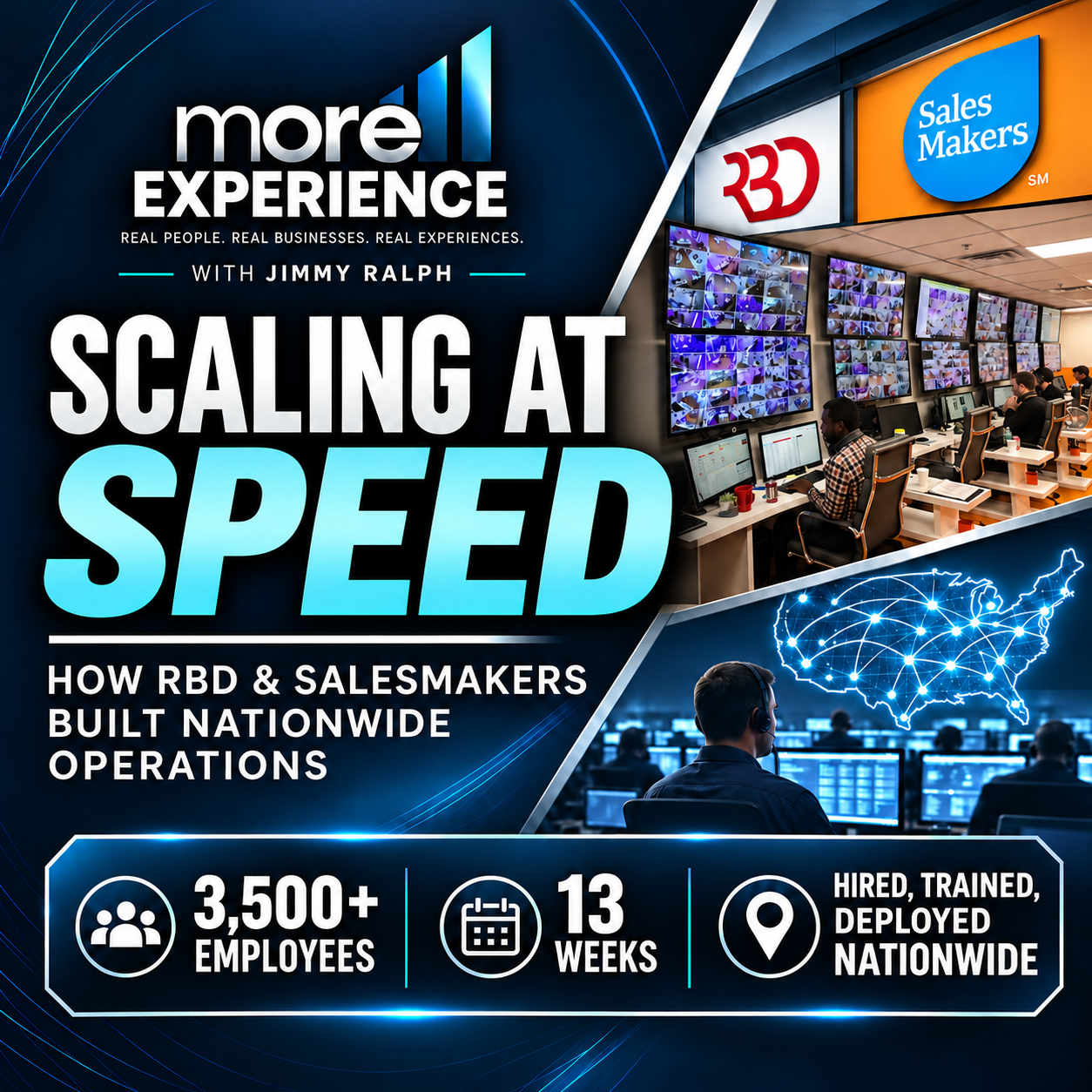
The RadioShack Challenge: 3,500 Employees in 13 Weeks – Rapid Scaling
In 2015, RadioShack filed for bankruptcy.
At the time, Sprint had a significant retail presence inside RadioShack stores, with wireless products and services being sold through dedicated areas within those locations.
The bankruptcy created an enormous operational challenge.
Sprint was facing the prospect of losing the employees responsible for staffing those retail programs.
According to the circumstances described in our podcast interview, approximately 1,400 stores needed staffing support, and the deadline was around 13 weeks away.
That was an extraordinary undertaking.
Think about what it takes to recruit, interview, hire, onboard, and train thousands of employees.
Now imagine doing that across most of the United States, with different markets, schedules, operating requirements, and management challenges.
And imagine having to complete it in approximately 90 days, scaling at that speed required precision.
The Phone Call That Changed Everything
I remember receiving the call while Julie and I were in Cancun celebrating our anniversary.
It was one of those moments when you immediately recognize that an opportunity is much larger than anything you’ve previously attempted.
Sprint needed an organization capable of deploying a national sales force on an extremely compressed timeline.
Because of our experience and relationships, they knew who to call.
We accepted the challenge.
There wasn’t much time to sit around discussing whether it would be difficult.
We knew scaling that fast would be difficult.
The question was how we were going to accomplish it.
Building an Organization at Extraordinary Speed
We began rapidly expanding our recruiting and training operations.
We converted office space into temporary recruiting centers, brought in additional personnel, and created the infrastructure necessary to process an enormous volume of candidates.
We had to build the organization while simultaneously delivering the project.
By the end of the 13-week period, we had recruited and deployed approximately 3,500 to 4,000 employees into the RadioShack retail program.
Was everything perfect?
Of course not, it can’t be when you’re scaling that fast.
But we accomplished something that many people believed couldn’t be done.
The experience reinforced a lesson I’ve carried into every major business challenge since.
When you face an extraordinary deadline, you need to stop focusing on how difficult the task looks and start building the systems and teams required to execute it.
That doesn’t mean ignoring risk or abandoning discipline.
It means giving capable people clear responsibilities, creating processes that can scale, and making decisions quickly enough to keep the organization moving.
Everpresent Management: A Different Way to Manage Retail Operations
One of the most important developments to emerge from our years operating nationwide retail programs was a management approach we called Everpresent Management, or EPM.
Traditional retail management relied heavily on layers of field supervisors.
You had store managers, district managers, regional managers, directors, and executives responsible for overseeing operations.
Those managers spent significant time traveling between locations, inspecting stores, evaluating employees, and making sure company standards were being followed.
That approach was expensive and difficult to execute consistently across a large geographic footprint.
We believed there had to be a better way of scaling.
Managing Thousands of Employees Without Being Everywhere
We developed technology-enabled processes that allowed us to manage employees and retail locations remotely.
Our operations center in St. Petersburg, Florida, looked more like a mission-control environment than a traditional retail office. That allowed scaling to happen much faster than a traditional management structure.
Through communications technology, reporting systems, and structured management processes, we could connect with employees across different markets and time zones.
Rather than relying solely on occasional visits from a district manager, we could communicate with teams every day.
We could reinforce training, review performance, address operational issues, and help employees feel connected to the broader organization.
As I explained during the podcast:
“We could put people in any store anywhere in the country and sell any product.”
That was the ambition behind our model.
And it represented a fundamentally different approach to scaling business operations.
Building Culture Through Consistent Communication
Technology was important, but the system wasn’t simply about monitoring performance.
It was also about building a culture.
We wanted employees to feel recognized, supported, and connected to the organization.
When someone began their shift, we wanted them to know that management was available, that their work mattered, and that they had the resources to succeed. When you’re scaling it can be easy to forget these basic principles.
We used daily communication to reinforce expectations, provide encouragement, and help people improve.
That created a level of consistency that would have been extremely difficult to maintain through traditional field visits alone.
Years later, when remote management became much more common during the COVID-19 pandemic, people were surprised to discover how extensively we had already incorporated those principles into our operations.
But we had been developing and using these methods well before remote work became mainstream.
Scaling doesn’t come from hiring more managers every time your business grows. It comes from developing systems that allow your existing organization to operate more effectively.
The Relationships That Made Large Opportunities Possible
I often get asked how a relatively small entrepreneurial company earns the trust of major corporations.
How do you convince Microsoft, Sprint, or another large organization to give you responsibility for an important part of its business?
There are several factors involved.
You need experience.
You need a track record.
You need people who can execute.
But one of the most important factors is relationships.
The people making these decisions need confidence that you understand their challenges and can be trusted to deliver.
They also need to know who you are.
In the podcast, I explain that meaningful relationships involve much more than collecting business cards or adding professional connections online.
You develop relationships by getting to know people, understanding their businesses, helping them solve problems, and building trust over time.
Those connections create opportunities that might never emerge through a traditional sales process.
The Sprint opportunity didn’t originate because someone randomly discovered us in an online search.
It came through an established reputation and relationships with people who understood our capabilities.
There’s an important distinction between knowing somebody and having a relationship with somebody.
The real value of your network is knowing who will answer the phone when you call, and who trusts you enough to make an introduction when it matters.
Throughout RBD and SalesMakers, those relationships became an extraordinary competitive advantage.
5 Lessons About Scaling Business Operations
Looking back on those years, five lessons stand out.
1. Build Systems Before You Need Them
A business that relies entirely on its founder or a small group of managers will eventually reach its operational limits.
Develop repeatable processes, reporting structures, and communication systems before growth makes them absolutely necessary.
2. Hire and Empower Capable People
You cannot scale a national organization by personally making every decision.
Find talented people, give them clear objectives, and trust them to execute.
Strong leadership creates more leaders.
3. Use Technology to Improve Management
Technology should help managers communicate, coach, measure performance, and solve problems more effectively.
The objective is better execution, not simply more software.
4. Be Willing to Solve Problems Differently
The fact that an industry has operated a certain way for decades doesn’t mean that approach is the best one.
Everpresent Management emerged because we questioned whether traditional field management was the most effective model for our business.
5. Invest in Relationships Before Opportunities Appear
Some of our largest projects came from people who already knew and trusted our organization.
You never know when a relationship will create an opportunity to solve a problem that changes the direction of your business.
Building the Foundation for What Came Next
The RBD and SalesMakers years were an extraordinary period of growth and learning.
We worked with major companies, managed difficult launches, navigated unexpected setbacks, and built the capability to recruit and lead large numbers of employees across the country.
We also developed operating systems, management expertise, and relationships that would become extremely valuable in the next chapter of my career.
At some point, we began asking an obvious question.
What if we took everything we’d learned helping other companies grow their retail operations and applied those capabilities to a business of our own?
We had the people.
We had the systems.
We had the experience.
And we had relationships across the telecommunications industry.
That thinking would become central to the expansion of Talk More Wireless, a business that would eventually grow into one of the largest Metro by T-Mobile retail organizations in the country.
But that story deserves its own chapter.
The biggest lesson from RBD and SalesMakers is that extraordinary growth requires more than ambition.
You need the people, processes, relationships, and execution capabilities to support it.
And when those elements come together, you can accomplish things that initially seem impossible.
That’s what entrepreneurship has always been about for me.
Recognizing opportunities, finding the right people, building the systems, and figuring out how to make things happen.
Real People. Real Businesses. Real Experiences.
Watch the RBD and SalesMakers episode of More Experience with Jimmy Ralph on YouTube, or listen on Spotify and Apple Podcasts, to hear the full stories behind these ventures.
By Jimmy Ralph | Entrepreneur, CEO of More³, and Host of More Experience
Want to stay up to date with Jimmy Ralph?
Follow Jimmy on LinkedIn | X (formerly Twitter) | YouTube | Instagram | Facebook for leadership insights, business lessons, behind-the-scenes updates, and more!
Follow the More Experience Podcast on: Apple Podcasts | Spotify | Youtube | X | Instagram | Facebook | LinkedIn
Follow More³ on: X | Instagram | Facebook | LinkedIn