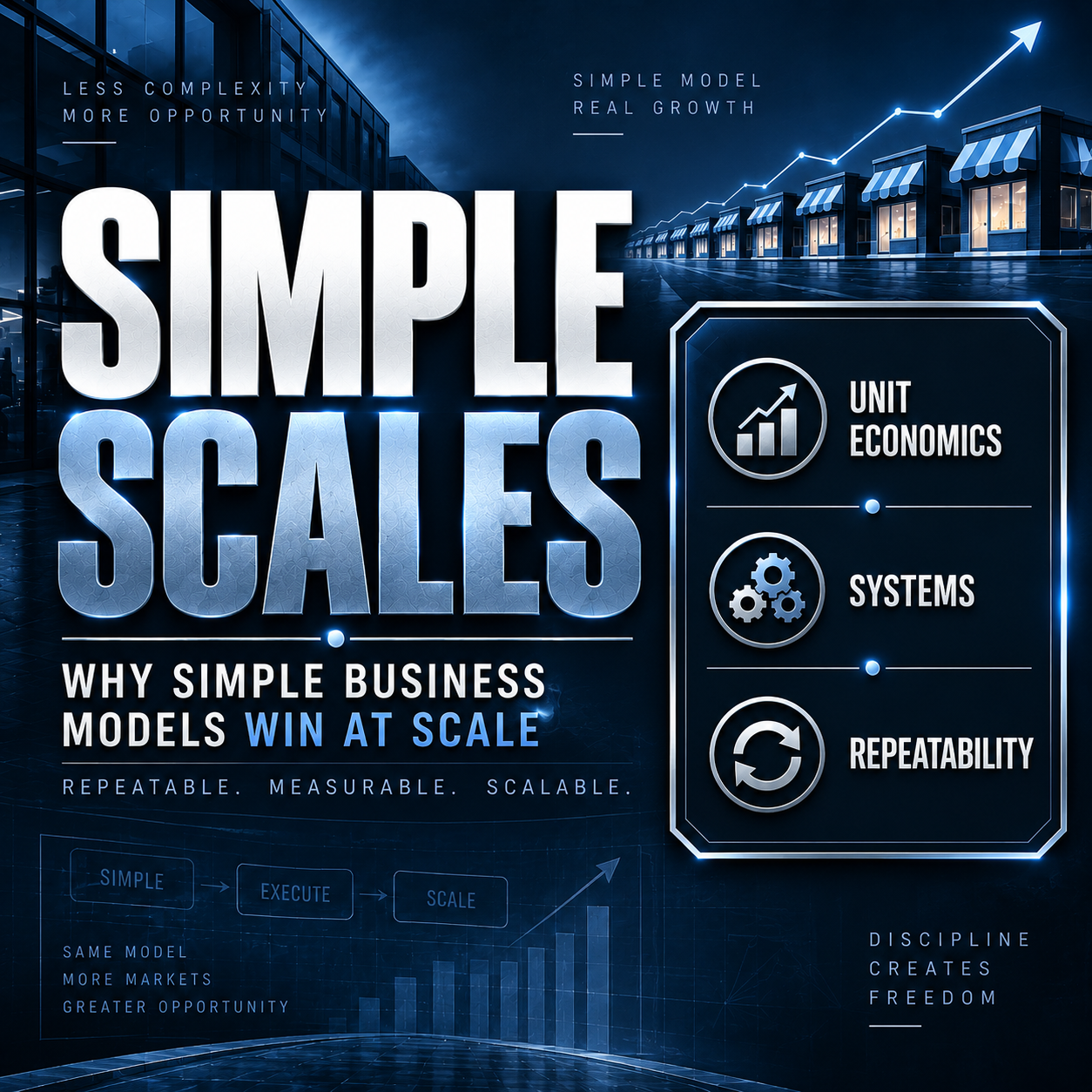
Simple Business Models: The Foundation of Scalable Success
Simple Business Models are often overlooked in a world that celebrates complexity, innovation, and disruption. Many entrepreneurs believe that the more sophisticated their business is, the more valuable it becomes.
In reality, the opposite is often true.
The businesses that scale the fastest, operate the most efficiently, and generate the most consistent results are built on Simple Business Models. They are easy to understand, easy to execute, and—most importantly—easy to replicate.
Jimmy Ralph has spent decades building and scaling companies across multiple industries, and one principle consistently stands out: simplicity wins. Not because it’s easy—but because it works.
The Myth of Complexity in Business
There’s a common belief in entrepreneurship that complexity equals value. More products, more services, more moving parts—it feels like growth.
But complexity creates friction.
Complex businesses are harder to:
- Train employees in
- Manage across locations
- Scale into new markets
- Maintain consistency
On the other hand, Simple Business Models remove friction. They allow leaders to focus on execution instead of constantly solving operational inefficiencies.
The goal is not to build something complicated. The goal is to build something that works—repeatedly.
Why Simple Business Models Scale Faster
Scaling a business is not about doing something once. It’s about doing the same thing consistently, across different locations, teams, and markets.
That’s where Simple Business Models create an advantage.
When your model is simple:
- Employees learn it faster
- Systems are easier to implement
- Performance is easier to measure
- Expansion becomes more predictable
A complex model may work in one location. A simple model can work in hundreds.
That’s the difference between a business and a scalable business.
Understanding the Power of Unit Economics
At the core of all Simple Business Models is one thing: clear unit economics.
Great operators break their business down to its simplest form:
- What does it cost to operate?
- What revenue does each unit generate?
- What is the margin per transaction or per location?
When you understand these numbers, everything becomes clearer.
You don’t need a complicated strategy. You need a repeatable formula.
For example, if a single unit produces consistent profit, the path to growth becomes obvious—replicate that unit at scale.
That’s how Simple Business Models turn into large businesses.
Simple Doesn’t Mean Easy
One of the biggest misconceptions about Simple Business Models is that they are easy to execute.
They’re not.
In fact, simple models often require more discipline because there’s nowhere to hide. Every inefficiency, every mistake, every breakdown becomes visible.
Execution becomes the differentiator.
Scaling a simple model across:
- Multiple states
- Hundreds of employees
- Thousands of transactions
…requires systems, training, accountability, and relentless consistency.
The model may be simple. The execution is not.
Building Systems Around Simplicity
To make Simple Business Models work at scale, you need systems that support them.
This includes:
- Training systems to ensure consistency
- Reporting systems to track performance
- Communication systems to align teams
- Operational systems to maintain standards
Jimmy Ralph’s approach to scaling businesses has always involved building infrastructure that reinforces simplicity. The goal is to create an environment where every employee knows exactly what to do—and how to do it well.
When systems are aligned with a simple model, scale becomes achievable.
Why Simplicity Improves Decision-Making
Another advantage of Simple Business Models is clarity.
When your business is easy to understand, decisions become easier to make.
You can quickly answer:
- Should we expand?
- Should we invest more capital?
- Where are we underperforming?
Complex businesses often struggle with these questions because there are too many variables. Simple businesses can move faster because the path forward is clearer.
In competitive markets, speed matters. Simplicity creates speed.
How to Simplify Your Business
If you want to leverage Simple Business Models, the first step is to strip your business down to its core components.
Ask yourself:
- What is the primary value we deliver?
- What are the key drivers of revenue?
- What processes can be standardized?
- What can be eliminated?
Most businesses don’t need to add more—they need to remove more.
Simplification leads to clarity. Clarity leads to better execution.
The Role of Environment in Refining Simplicity
Simplifying a business is not always easy when you’re operating inside it every day. That’s where environment becomes critical.
When you’re surrounded by other experienced operators, you gain perspective. You see how others structure their businesses, where they eliminate inefficiencies, and how they scale effectively.
Being part of a CEO community like Board of Advisors provides that exposure. It allows leaders to refine their approach, challenge assumptions, and identify ways to simplify faster.
Simple Business Models are often the result of experience, collaboration, and continuous improvement.
Why Simple Business Models Win Long-Term
At the highest level, business success is not about complexity—it’s about consistency.
The companies that win over time are the ones that:
- Execute reliably
- Scale efficiently
- Maintain quality across growth
All of this is easier to achieve with Simple Business Models.
They create alignment across teams. They reduce operational risk. They allow leaders to focus on growth instead of constantly fixing problems.
And over time, that consistency compounds into significant competitive advantage.
Final Thought
If you’re trying to scale your business, don’t start by adding more.
Start by simplifying.
The most successful operators understand that Simple Business Models are not a limitation—they are a strength. They create clarity, enable execution, and make scale possible.
Because in the end, the businesses that grow the largest are not the most complicated.
They’re the most repeatable.
Lived By: Jimmy Ralph
CEO Board of Advisors
Interesting in joining the BA Community? bainvite.com
Want to stay up to date with Jimmy Ralph?
Follow Jimmy on LinkedIn | X (formerly Twitter) | YouTube | Instagram | Facebook for leadership insights, business lessons, behind-the-scenes updates, and more!
Visit Board of Advisors website
Board of Advisors magazine | Board of Advisors X | Board of Advisors Youtube | Board of Advisors Instagram
Shameless Plug time: If you’re in the St. Pete/Tampa area and are in need of drone/video filming services then check out my nephew’s company HR Video & Drone!